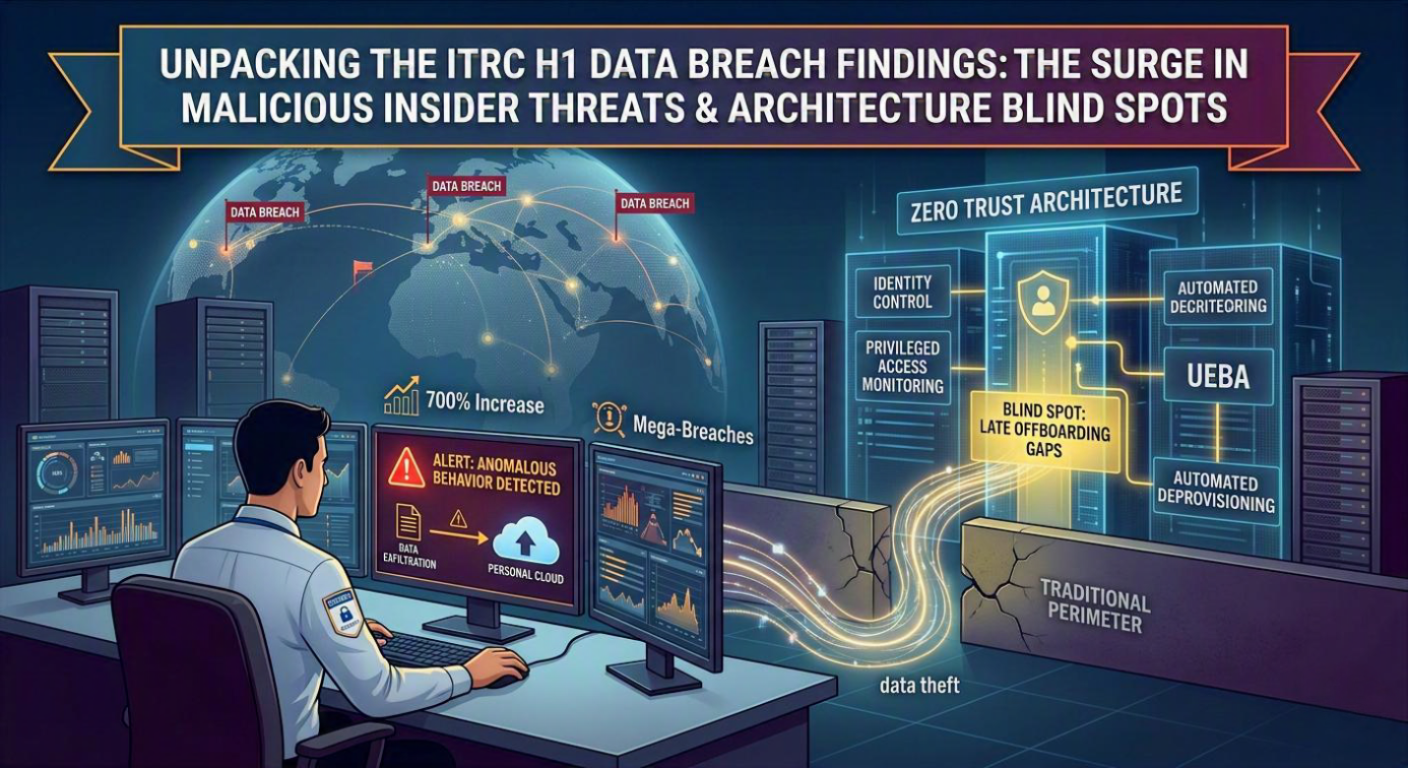
The recent release of the Identity Theft Resource Center H1 Data Breach Report delivers a stark reality check for security leaders, Enterprise Security Architects, and Zero Trust practitioners. In the first six months of the year, corporate risk profiles underwent a dramatic shift: total data compromises reached 1,803 events, putting the year on pace to top 3,600 total incidents. At the same time, over 471 million victim notifications were issued, completely eclipsing the 297.5 million notifications recorded across all twelve months of the prior year.
While mega-breaches and zero-day exploits continue to dominate headlines, the most critical architectural signal in the data is the quiet explosion of internal risk. The report documents a sevenfold surge in malicious insider incidents, exposing fundamental gaps in traditional identity governance, privileged access monitoring, and offboarding workflows.
For teams building resilient defenses from the inside out, the ITRC dataset provides essential telemetry on where legacy perimeters are failing and how modern insider risk frameworks must evolve.
The Insider Threat Surge: Quantifying the Shift
The Identity Theft Resource Center identified 21 distinct malicious insider events in the first half of the year, compared to just 3 incidents across the entirety of the previous year. This raw statistical leap reflects a shift in how threat actors gain footholds within target networks and how employees monetize their access.
| Reporting Period | Malicious Insider Incidents | Year-over-Year Shift |
| Previous Full Year | 3 Total Incidents | Baseline |
| Current H1 | 21 Total Incidents | 700% Increase |
Several converging operational factors are driving this acceleration:
- Economic Stressors and Workforce Volatility: Reorganizations, tech-sector layoffs, and inflation have heightened financial pressures on employees and contractors, creating fertile ground for insider recruitment.
- “Insider-as-a-Service” Monetization: Dark web brokers and ransomware affiliates actively solicit corporate insiders, offering direct cash or cryptocurrency payouts in exchange for active VPN tokens, session cookies, or privileged database credentials.
- The Pre-Departure Window: Departing personnel frequently leverage their existing read/write privileges during their standard two-week notice window to exfiltrate proprietary source code, customer databases, and strategic intellectual property to personal cloud storage.
As highlighted in the Identity Theft Resource Center Weekly Breach Breakdown Podcast, social engineering and phishing continue to blur the line between negligent and malicious insiders. Furthermore, detailed reporting by HIPAA Journal emphasizes that compromised internal credentials remain a primary catalyst for unauthorized lateral movement within healthcare and enterprise environments alike.
Key Data Trends and Architectural Failure Modes
Beyond the headline numbers, a granular analysis of the ITRC telemetry highlights three critical operational failure modes that every security team must evaluate.
1. The Transparency Gap in Vulnerability Tracking
Only 24 percent of breach notices issued in H1 disclosed the specific initial attack vector involved, marking the lowest transparency rate ever recorded by the ITRC. When organizations fail to publicly disclose whether an intrusion stemmed from an unpatched gateway, a stolen session cookie, or a rogue insider, peer defense teams are left blind. This lack of threat visibility hinders architects from baselining emerging insider patterns against real-world attack chains.
2. Supply Chain and Zero-Day Multipliers
Zero-day exploitation events rose to 14 in H1, rapidly approaching the 17 total events recorded across the previous full year. Simultaneously, 38 supply chain breach events impacted 206 third-party entities and generated over 280 million victim notices.
From an insider risk perspective, third-party vendor access represents an expanded internal attack surface. Contractors, external service desks, and integrated SaaS applications often possess broad data access rights without being subject to the same behavioral telemetry and background checks as direct full-time staff.
3. Deprovisioning and Offboarding Delays
A recurring theme across recent corporate incidents is the gap between HR termination and identity provider (IdP) deprovisioning. Active directory accounts, SSH keys, and API tokens left unrevoked for hours or days after an employee’s exit provide a clear window for retaliatory data destruction or bulk exfiltration.
Operational Blueprints: Mitigating Internal Risk from the Inside Out
Preventing insider compromise requires moving beyond perimeter-focused defenses and point-in-time compliance checks. Security teams must deploy continuous verification architectures designed to detect, restrict, and neutralize anomalous behavior at the data layer.
| Defense Domain | Legacy Approach | Secure From Inside Blueprint |
| Identity Control | Static Role-Based Access Control (RBAC) | Just-in-Time (JIT) access with zero persistent admin privileges |
| Data Protection | Perimeter Egress Filtering & Basic DLP | Outbound traffic inspection, cloud app blocking, and endpoint USB control |
| Authentication | SMS or Push-Notification MFA | FIDO2/WebAuthn hardware tokens enforcing device-bound session binding |
| Telemetry & Auditing | Disconnected System Logs & SIEM Ingestion | Unified User and Entity Behavior Analytics (UEBA) tracking activity baselines |
Blueprint 1: Enforce Strict Least Privilege and JIT Access
Persistent administrative access is an open invitation for insider abuse. Implement Just-in-Time (JIT) access workflows where elevated permissions are granted dynamically for specific tasks and automatically revoked upon completion. Pair JIT with Attribute-Based Access Control (ABAC) to restrict access based on user role, device trust state, time of day, and physical location.
Blueprint 2: Implement User and Entity Behavior Analytics (UEBA)
Traditional rules-based SIEM alerts fail to catch malicious insiders because the activity originates from a legitimate, authenticated user session. Deploy UEBA tools to baseline individual user behavior and trigger alerts on anomalous deviations, such as:
- Sudden spikes in bulk document downloads or export requests.
- First-time access to high-value code repositories or sensitive database tables.
- Access attempts outside normal working hours or from unrecognized ASN (Autonomous System Number) ranges.
Blueprint 3: Deploy Phishing-Resistant MFA and Session Binding
To counter credential theft and “Insider-as-a-Service” token sales, eliminate legacy MFA methods like SMS and push notifications. Standardize on hardware-backed FIDO2/WebAuthn passkeys that enforce cryptographic origin binding. Ensure session tokens are tied directly to the device context to prevent stolen session cookies from being reused on external adversary infrastructure.
Blueprint 4: Automate Deprovisioning via HRIS Integration
Eliminate human delay in the offboarding pipeline by establishing direct webhooks between the Human Resources Information System (HRIS) and the Primary Identity Provider (IdP). When an employee status changes to “Terminated” or “Resigned” in HRIS, the integration should instantly execute an automated workflow:
- Revoke active OAuth and SSO sessions across all SaaS applications.
- Disable active Directory and IdP accounts.
- Invalidate active VPN profiles, SSH keys, and personal API tokens.
- Wipe corporate partitions on managed endpoint hardware.
Strategic Summary for Security Leaders
The findings detailed in the Identity Theft Resource Center Report confirm that insider threats are no longer edge-case anomalies; they are a primary driver of enterprise exposure.
Securing the enterprise requires assuming that the perimeter is already breached and that valid credentials will occasionally fall into the wrong hands or be leveraged by disgruntled employees. By embedding Zero Trust principles deep within the internal architecture, enforcing strict identity boundaries, and monitoring real-time behavioral telemetry, security teams can contain internal risk and protect critical assets from the inside out.
Sources and Further Reading