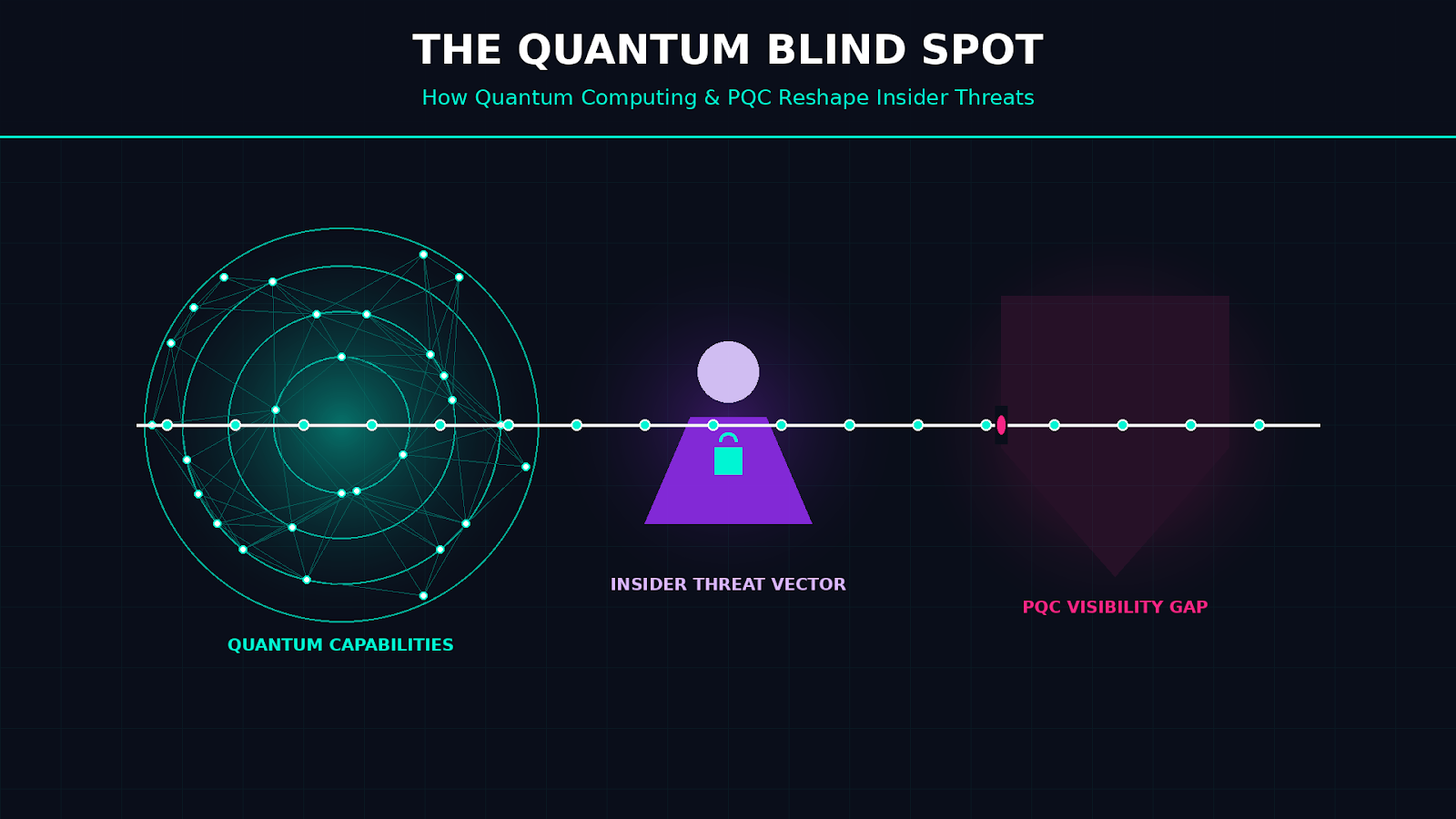
When security leaders debate quantum computing, the conversation almost always focuses on external, nation-state actors breaking public key encryption to breach corporate perimeters. We envision high-tech quantum facilities cracking RSA and ECC algorithms from afar.
Yet this framing misses a critical vulnerability: the insider.
As quantum processing evolves and organizations begin the multi-year migration to Post-Quantum Cryptography (PQC), we are creating a dangerous blind spot. The transition to quantum-safe environments will not just defend against external hackers. It will fundamentally alter the capabilities, motivations, and invisibility of malicious and negligent insiders.
The intersection of quantum capabilities, PQC migration, and internal risk management represents a new frontier for enterprise security architecture.
1. The Supercharged Malicious Insider
Malicious insiders already hold legitimate network credentials, possess localized access, and understand organizational workflows. Quantum capabilities, accessed via cloud-based quantum services or localized processing units, multiply their offensive potential.
Accelerating Forensic Evasion
Traditionally, an insider attempting to cover their tracks spends considerable time attempting to brute-force administrative hashes, alter system logs, or bypass internal checks. Classical security tools detect these actions through volume spikes and persistent failed attempts.
Using algorithms like Shor’s or Grover’s, a quantum-capable insider could execute offline password cracking and hash collision attacks in fractions of the time required by classical hardware. The timeframe for an administrative credential compromise drops from weeks to seconds, effectively blinding Security Operations Center (SOC) teams before anomalous behavior can trigger an incident response playbook.
Amplification of “Harvest Now, Decrypt Later”
The risk of “Harvest Now, Decrypt Later” (HNDL) is widely discussed in the context of external network interception. However, an insider executing HNDL presents a far more immediate threat.
Traditionally, an exfiltrated file that is strongly encrypted at rest provides a partial safety net. If a departing employee steals a database encrypted with classical algorithms, they still require the master key. In the quantum era, a malicious insider can quietly exfiltrate massive volumes of strongly encrypted corporate trade secrets, source code, or customer health data today. They do not need to steal the key. They simply hold the encrypted payload until quantum decryption becomes operationally accessible to them.
Digital Signature and Code Forgery
If an internal developer or system administrator gains cryptanalytic quantum capabilities, digital signatures can no longer be trusted as a sole measure of integrity. An insider could forge internal signing certificates, inject unauthorized backdoors into production firmware, and sign the release. The payload would bypass internal Zero Trust software checks and automated deployment pipelines, appearing as a verified update.
2. The Dark Side of PQC: The Visibility Gap
To counter quantum threats, the National Institute of Standards and Technology (NIST) finalized initial PQC standards, including ML-KEM and ML-DSA. However, deploying these new cryptographic primitives introduces severe visibility challenges for insider threat detection programs.
Data Loss Prevention (DLP) Black Holes
Enterprise security relies heavily on Data Loss Prevention (DLP) platforms and deep packet inspection (DPI) to monitor outbound network traffic for sensitive data leaks. These tools often execute inline SSL/TLS decryption to inspect payload content.
PQC protocols feature significantly larger key sizes, unique handshake structures, and increased computational overhead compared to classical public-key systems. As applications begin utilizing quantum-resistant tunnels, inline network security appliances that do not fully support PQC decryption will fail open or bypass inspection entirely. A tech-savvy insider can route data exfiltration through PQC-encrypted channels, rendering traditional DLP solutions blind to the egress of sensitive files.
“Shadow PQC” as an Exfiltration Tool
Just as security teams currently struggle with Shadow IT and unapproved Generative AI tools, “Shadow PQC” is emerging as a unique risk. A malicious employee can deploy unauthorized, standalone PQC encryption utilities to encrypt staged data directly on corporate endpoints. Security teams will observe large encrypted archives, but without visibility into the custom PQC key exchange, they will be unable to determine what was stashed or decrypt the data during a forensic investigation.
Migration Chaos and Cryptographic Seams
Migrating an enterprise to post-quantum cryptography is a complex, years-long effort. During this extended transition, organizations will operate hybrid environments where PQC algorithms run alongside legacy RSA and ECC infrastructure.
Insiders who understand these operational seams can exploit the gaps. They might target legacy systems where monitoring has been temporarily scaled back to accommodate PQC testing, or move data between old and new systems where logging policies are inconsistent.
3. The Negligent Insider in a Quantum World
Insider risks are not always malicious; negligence and accidental policy bypasses account for more than half of all internal security incidents. The sheer operational complexity of shifting to PQC will trigger significant human error.
Cryptographic Misconfigurations
PQC algorithms rely on complex mathematical structures, such as lattice-based cryptography, that differ drastically from traditional algorithms. Developers, system architects, and administrators who lack specialized cryptographic training will make mistakes during deployment. Misconfigured hybrid key exchanges, improper implementation of initialization vectors, or flawed certificate bindings will introduce zero-day vulnerabilities, exposing data to internal and external threats alike.
Key Management Overload and Shortcut Behaviors
PQC requires strict crypto-agility, frequent key rotations, and management of massive certificate chains. System administrators overwhelmed by managing thousands of new quantum-safe keys may resort to dangerous shortcuts:
- Storing private keys in plaintext or hardcoding them into source code repositories.
- Disabling strict certificate revocation checks to prevent network downtime during migration.
- Sharing master administrative credentials over unencrypted internal communication channels to speed up PQC deployment tasks.
Strategic Imperatives for Security Leaders
To prevent quantum computing and the PQC migration from eroding internal security, organizations must adapt their insider threat management strategies immediately.
- Achieve Total Cryptographic Inventory and Visibility: You cannot secure what you cannot see. Organizations must build an active, automated inventory of all certificates, keys, and algorithms running across their environment as recommended by NIST.
- Upgrade Security Inspection Platforms Alongside PQC Deployments: Ensure that inline monitoring tools, including Next-Generation Firewalls (NGFW) and DLP platforms, receive hardware and software updates capable of decrypting and inspecting PQC-secured traffic.
- Shift to Context-Based Zero Trust Data Controls: Encryption alone is no longer a silver bullet due to HNDL threats. Protect data by enforcing strict Zero Trust architecture, context-aware Identity and Access Management (IAM), and behavioral monitoring (UEBA) to detect anomalous data access regardless of how that data is encrypted at rest.
- Enforce Crypto-Agility Without Sacrificing Policy: Establish centralized, automated Key Management Services (KMS) to manage PQC keys. Automating key rotation prevents administrators from taking manual shortcuts that compromise enterprise hygiene.
The quantum era is not just an external technical challenge; it is a fundamental transformation of internal digital risk. Security leaders who evaluate how quantum capabilities and PQC deployments impact user behavior, visibility, and internal controls will be the ones who successfully defend their organizations across the quantum frontier.
References and Sources
- National Institute of Standards and Technology (NIST): Post-Quantum Cryptography Standardization and Migrationhttps://www.nist.gov/pqc
- NIST National Cybersecurity Center of Excellence (NCCoE): Migration to Post-Quantum Cryptography Projecthttps://www.nccoe.nist.gov/applied-cryptography/migration-to-pqc
- R Street Institute: Post-Quantum Cryptography Migration in the United States: Managing Risk and Advancing Cyber Readiness in Critical Infrastructurehttps://www.rstreet.org/research/post-quantum-cryptography-migration-in-the-united-states-managing-risk-and-advancing-cyber-readiness-in-critical-infrastructure/
- NHI Management Forum: Post-Quantum Encryption Readiness and Harvest Now Decrypt Later Governancehttps://nhimg.org/community/cybersecurity-beyond-identity/post-quantum-encryption-by-2029-what-should-security-teams-do-now/
- Palo Alto Networks: NIST PQC Migration Strategies, Steps, and Standards & Harvest Now, Decrypt Later Analysishttps://www.paloaltonetworks.com/cyberpedia/harvest-now-decrypt-later-hndl
- Keyfactor: Understanding Harvest Now, Decrypt Later (HNDL) Threat Vectorshttps://www.keyfactor.com/education-center/what-is-harvest-now-decrypt-later-hndl/