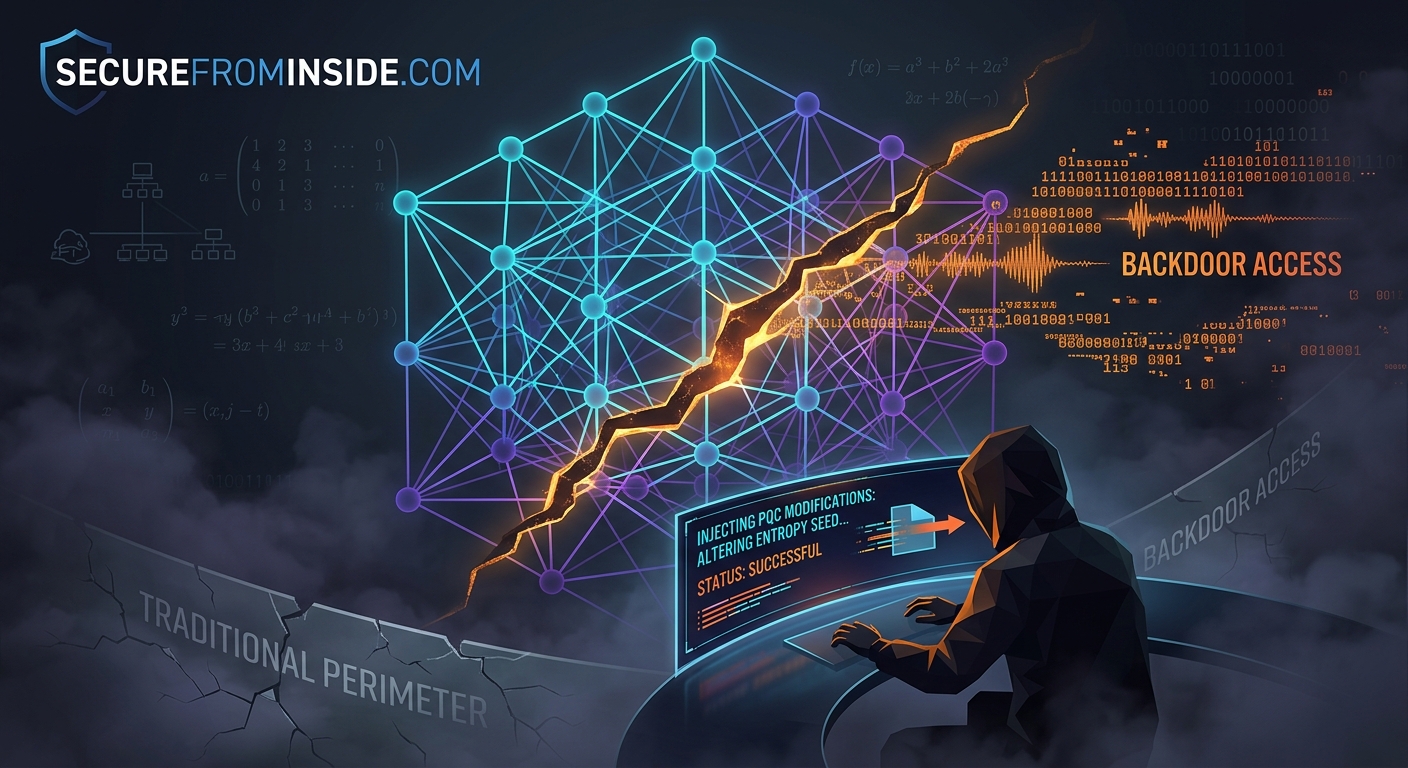
The global transition to Post-Quantum Cryptography (PQC) represents one of the largest infrastructure overhauls in digital security history. Following the publication of official standards by the National Institute of Standards and Technology, including NIST FIPS 203, FIPS 204, and FIPS 205, enterprise engineering teams are actively updating software libraries, identity systems, and network gateways.
While security leaders focus on protecting data against future quantum decryption, this massive refactoring push creates an immediate internal vulnerability. Upgrading classical encryption (like RSA and ECC) to complex lattice-based algorithms requires modifying millions of lines of code. For a malicious insider, whether a disgruntled developer, a compromised administrator, or a third-party contractor, this period of heavy code churn creates a perfect “fog of war” to plant stealthy backdoors hiding behind complex quantum math.
Why PQC Code Migration Creates Insider Risk
Most software developers and code reviewers do not possess advanced doctorates in lattice cryptography. When reviewing standard code, a peer reviewer can easily spot an unvalidated input field or an exposed hardcoded password. However, when reviewing code that implements polynomial math, module-learning-with-errors parameters, or custom noise sampling loops, reviewers frequently defer to the author.
This knowledge asymmetry allows a rogue insider to introduce intentional flaws that pass routine peer reviews, unit tests, and static application security testing (SAST) tools. To the rest of the organization, the new code looks like a state-of-the-art security upgrade, while to the insider, it serves as a secret doorway.
As emphasized by guidance from the CISA Post-Quantum Cryptography Initiative, managing quantum migration requires securing the software supply chain and keeping strict visibility over cryptographic assets.
Four Ways an Insider Can Exploit the PQC Transition
1. Rigging the “Digital Lock Maker” (Entropy and Randomness Flaws)
Encryption keys depend on randomness. If a key is truly random, no adversary can guess it.
During a PQC migration, an insider working on key generation logic can subtly tweak the pseudo-random number generator (PRNG) or the entropy seed used specifically for post-quantum key pairs. To an outside auditor, the lock appears brand new and functional. In reality, the insider has rigged the key generator so that all generated keys fall into a small, predictable mathematical range that only the insider knows how to calculate and unlock.
2. Building a Secret Master Key (Kleptography)
Lattice-based Key Encapsulation Mechanisms (KEMs) rely on complex noise sampling formulas to scramble data. An insider can modify these mathematical parameters to embed what cryptographers call a kleptographic backdoor.
Think of this as installing a lock that functions normally for everyday employees, but secretly contains a secondary master key slot on the back. The organization encrypts its files using the new PQC standard, but the insider, holding their hidden asymmetric key, can intercept and decrypt any file traversing the network without triggering alarms.
3. Forcing System Fallbacks (“Easy Mode” Triggers)
Most enterprise migration plans rely on hybrid cryptography during the transition phase, running classical encryption alongside post-quantum algorithms to preserve backwards compatibility.
A rogue engineer can embed conditional fallback logic into the key negotiation handler. For instance, they can write code that causes the server to silently drop the post-quantum layer and fall back exclusively to vulnerable legacy algorithms whenever a specific, secret request header is present in incoming traffic.
4. Leaking Keys Through “Timing Signals” (Side-Channel Exploits)
Post-quantum calculations require significant processing power. To remain secure, cryptographic code must execute in strictly constant time, meaning a calculation takes the exact same number of CPU cycles regardless of the secret key values being processed.
An insider can intentionally introduce microsecond-level timing variations into the mathematical execution loops. Over a standard network connection or shared cloud environment, the insider can measure these microscopic delays to gradually reconstruct private keys byte by byte.
Operational Blueprint: How Security Teams Neutralize PQC Insider Threats
To protect the organization during a PQC migration, security architects must move away from trusting individual developers and establish continuous verification controls across the development lifecycle, as recommended by the NIST NCCoE Migration to Post-Quantum Cryptography Project.
| Risk Vector | Legacy Approach | Secure From Inside Blueprint |
| Custom PQC Code | Internal teams write custom wrappers | Strictly mandate pre-audited, signed libraries (e.g., OpenSSL 3.x) |
| Code Tampering | Standard single-reviewer PR checks | Mandatory multi-peer reviews plus deterministic, reproducible builds |
| Hidden Backdoors | Static application code scanning | Continuous behavioral monitoring (UEBA) at the data layer |
| Key Extraction | Trusting valid user credentials | Hardware-bound passkeys (FIDO2) and real-time egress filtering |
Step 1: Never Allow Custom In-House PQC Implementations
Organizations should strictly prohibit internal engineering teams from writing custom implementations of PQC algorithms from scratch. All applications must pull from well-vetted, open-source cryptographic libraries that undergo continuous global peer review.
Step 2: Enforce Reproducible Builds and Multi-Peer Reviews
Every code change modifying security settings, key generation, or cryptographic libraries must require approval from at least two senior security architects/engineers. Furthermore, deployment pipelines must enforce deterministic, reproducible builds to ensure that the binary running in production matches the exact approved source code repository.
Step 3: Implement User and Entity Behavior Analytics (UEBA)
Backdoors are built to evade traditional signature-based detection, but they cannot hide the physical movement of stolen data. Deploy UEBA controls to monitor behavioral baselines. If an internal account or service key suddenly begins downloading high volumes of database backups or exporting proprietary files, automated policies should immediately terminate the session regardless of whether valid PQC credentials were used.
Strategic Takeaway for Security Leaders
The transition to post-quantum cryptography is an operational necessity, but it cannot be executed blindly. As noted in the Cloud Security Alliance Analysis on Finalized NIST Standards, organizations must pair algorithm upgrades with robust identity governance. By treating cryptographic refactoring as a high-risk supply chain event, enforcing strict peer oversight, and deploying behavioral telemetry, security teams can modernize their encryption while staying protected from the inside out.
Sources and Further Reading