Detecting malicious insider threat actors presents one of the most complex challenges in modern cybersecurity. Unlike external threat actors attempting to break through perimeter firewalls, malicious insiders already possess valid credentials, legitimate network access, and intimate knowledge of where an organization’s most valuable assets reside.
Because insider attacks leverage legitimate access, standard rule-based security tools often miss the early stages of an attack chain. Catching a malicious insider requires security operations teams to look beyond basic signature matching. It demands a comprehensive approach that fuses digital anomalies with human behavioral indicators.
Below is an in-depth guide to identifying the early warning signs of malicious insider activity and implementing technical and operational controls to neutralize the risk.
Technical Anomaly Indicators
Malicious insiders rarely execute data exfiltration or system sabotage spontaneously. They usually engage in a preparation phase that leaves clear digital footprints across enterprise systems.
1. Abnormal Data Accumulation and Staging
Before stealing proprietary data, insiders often consolidate information. Security teams should monitor for:
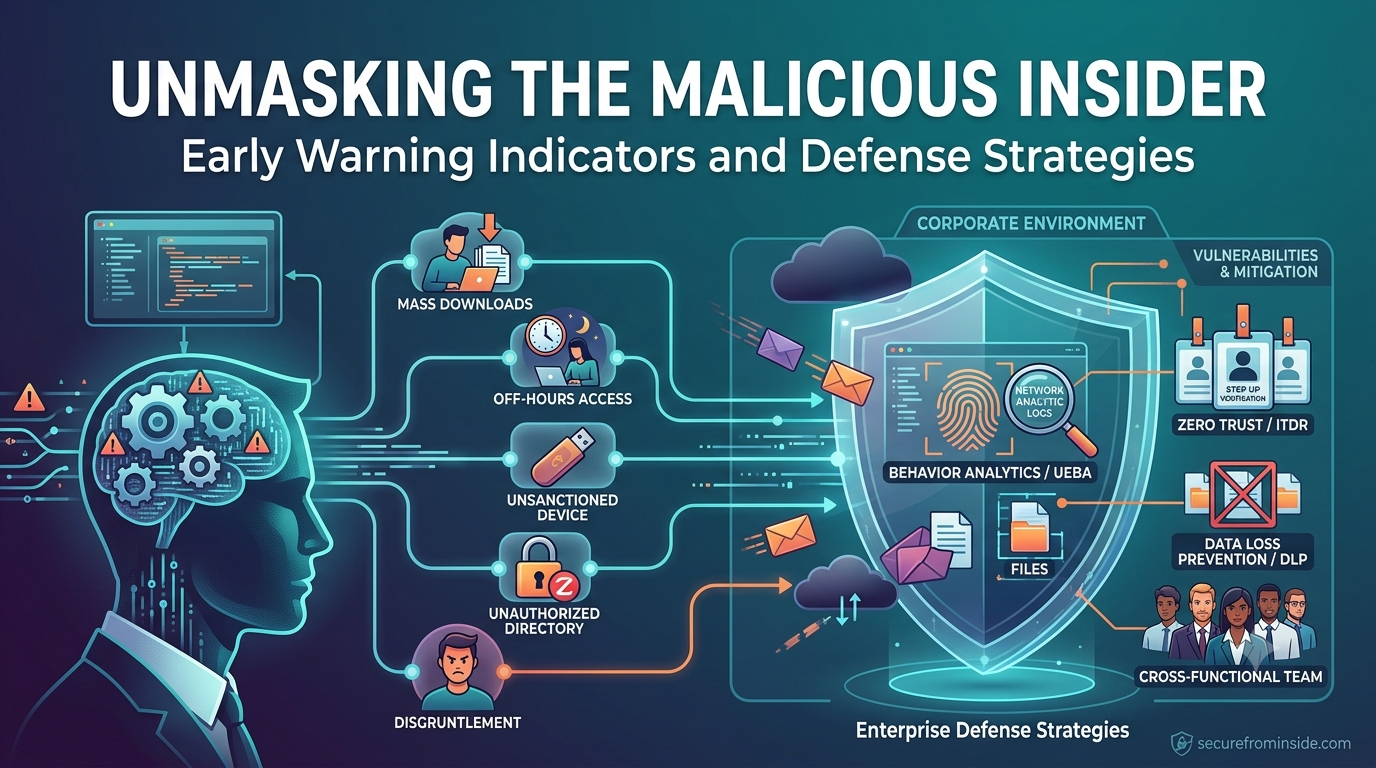
- Systematic Mass Downloads: A user querying, pulling, or exporting significantly higher volumes of files than their historical baseline or peer group average.
- Accessing Off-Scope Repositories: Employees attempting to open directories, databases, or project drives completely unrelated to their job function, such as a software engineer browsing financial ledgers or an HR specialist inspecting source code repositories.
- Local Archive Creation: The creation of large, compressed files (e.g., .zip, .7z, or .tar) or encrypted containers stored in temporary directories on local endpoints.
2. Off-Hours System Activity Spikes
While remote and flexible work makes off-hours access common, specific timing anomalies warrant scrutiny:
- Off-Peak Admin Operations: High-privilege tasks performed during windows when administrative oversight is low, typically between 01:00 and 04:00 local time.
- Access During Scheduled Absence: Logins originating from an employee’s user account while they are marked as out-of-office, on extended medical leave, or on paid time off.
3. Active Evasion Tactics and Guardrail Bypass
Insiders aware of security monitoring often attempt to hide their tracks:
- Log Clearing and Audit Disabling: Commands executed to wipe event logs, terminate endpoint detection agents, or clear shell histories.
- File Masquerading: Renaming sensitive archive files to benign extensions (e.g., changing .zip to .png) to trick basic perimeter controls.
- Unapproved Anonymization Tools: Downloading or running VPNs, Tor browsers, or proxy tools on corporate devices to obscure outbound network connections.
4. Privilege Escalation Probing
Insiders seeking broader access often test the limits of their permissions:
- Repeated Access Denied Errors: A sudden cluster of failed permission requests as a user attempts to navigate restricted database segments.
- Unauthorized Account Creation: Attempts to generate secondary local administrator accounts or provision unauthorized service principal keys in cloud environments.
Human Behavioral Indicators
Digital alerts tell only half the story. The Cybersecurity and Infrastructure Security Agency (CISA) emphasizes that observing concerning physical and interpersonal behaviors provides crucial context for preventing insider incidents before technical damage occurs.
1. Active Disgruntlement and Policy Violations
An employee’s workplace attitude often changes prior to a malicious act:
- Expressed Resentment: Repeated verbal or written grievances expressed over missed promotions, compensation disputes, or pending organizational restructuring.
- Deliberate Security Bypass: A pattern of ignoring security policies, such as tailgating into secure areas, disabling security controls on local laptops, or sharing credentials.
2. High-Risk Offboarding Windows
The window surrounding an employee’s departure is statistically the highest-risk period for intellectual property theft:
- Pre-Resignation Exfiltration: Studies show a marked increase in data downloads within 30 to 60 days before an employee submits their notice, particularly when moving to a direct competitor.
- Abrupt Disengagement: A sudden drop in daily project collaboration combined with a spike in personal file collection right after a formal resignation notice.
3. Unexplained Financial Shifts or Personal Distress
Extenuating personal circumstances can make individuals vulnerable to external recruitment, financial fraud, or espionage:
- Acute Financial Distress: Employees making open inquiries about immediate cash advances or expressing severe personal debt.
- Unexplained Affluence: Displaying sudden, unexplained wealth inconsistent with their known income level.
Enterprise Mitigation Strategies
Mitigating the threat of a malicious insider requires technical architectures and organizational processes working together.
Technical Mitigations
1. Implement User and Entity Behavior Analytics (UEBA)
Traditional rule-based Security Information and Event Management (SIEM) systems fail to catch insiders because the user’s credentials are valid. UEBA platforms solve this by applying machine learning to establish a dynamic baseline of “normal” for every user, service account, and device.
- Peer Group Analysis: UEBA compares an individual’s actions against their dynamic peer group (e.g., comparing one financial analyst against all financial analysts in the same office).
- Fused Risk Scoring: Instead of firing isolated alerts for minor events, UEBA combines multiple low-confidence signals (such as an off-hours login plus an unusually large cloud download) into a single high-priority risk score.
2. Enforce Least Privilege and Zero Trust Architecture
Following the guidance of NIST Special Publication 800-207, organizations must operate under the assumption that internal networks are inherently untrusted.
- Role-Based Access Control (RBAC): Restrict access strictly to the data and applications required for an employee’s immediate job function.
- Just-In-Time (JIT) Elevation: Utilize Privileged Access Management (PAM) platforms that grant temporary elevated permissions only when a specific business justification is submitted and approved.
3. Deploy Inline Data Loss Prevention (DLP)
DLP platforms enforce organizational data handling policies by inspecting data movement at endpoint, network, and cloud layers:
- Egress Blocking: Automatically prevent sensitive files (e.g., source code, customer PII) from being transferred to unapproved USB storage devices, personal webmail accounts, or non-corporate cloud storage apps.
- Watermarking and Classification: Label sensitive files automatically upon creation to track their distribution and movement across the corporate environment.
Organizational and Process Mitigations
1. Form a Cross-Functional Insider Risk Team
Technical monitoring tools cannot evaluate workplace context effectively on their own. Effective mitigation requires a dedicated insider threat program that integrates key stakeholders across the business:
- Human Resources: Identifies high-risk indicators such as disciplinary actions, pending layoffs, or formal resignations.
- Legal and Compliance: Ensures that employee monitoring policies adhere to regional privacy regulations (such as GDPR) and labor laws.
- Information Security / SOC: Monitors telemetry, triages technical alerts, and executes technical containment playbooks.
2. Automate Lifecycle Access Revocation
A common vulnerability is “access creep”—where employees retain access permissions from previous internal roles—or delayed access termination following offboarding.
- Automated HR Synchronization: Integrate Human Resource Information Systems (HRIS) directly with Identity and Access Management (IAM) platforms.
- Instant Deprovisioning: When an employee is marked as terminated in HR systems, their digital identity, active network sessions, cloud tokens, and physical access badges should automatically revoke in real time.
3. Protect High-Risk Departure Windows
Place departing employees, contractors, and individuals undergoing disciplinary reviews on heightened monitoring profiles within your DLP and UEBA systems. Require return of all corporate assets and execute thorough digital audits prior to an employee’s final day.
Referenced Frameworks and Sources
- Cybersecurity and Infrastructure Security Agency (CISA): Insider Threat Mitigation Framework & Guidance
https://www.cisa.gov/topics/physical-security/insider-threat-mitigation
- Adaptive Security: How to Build an Insider Threat Program That Actually Reduces Risk
- NetWitness: Insider Threat Mitigation: Strategies and Behavioral Analytics
- Fortinet: Enterprise Strategies to Defend Against Insider Threats
https://www.fortinet.com/resources/articles/strategies-to-defend-against-insider-threats
- Palo Alto Networks: User and Entity Behavior Analytics (UEBA) Cyberpedia
https://www.paloaltonetworks.com/cyberpedia/what-is-user-entity-behavior-analytics-ueba
- Vectra AI: UEBA Explained: User and Entity Behavior Analytics Guide
https://www.vectra.ai/topics/user-and-entity-behavior-analytics-ueba
- Group-IB Knowledge Hub: What Is UEBA in Cybersecurity?
https://www.group-ib.com/resources/knowledge-hub/what-is-ueba
- IBM Security Think: Understanding User and Entity Behavior Analytics (UEBA)

Leave a Reply