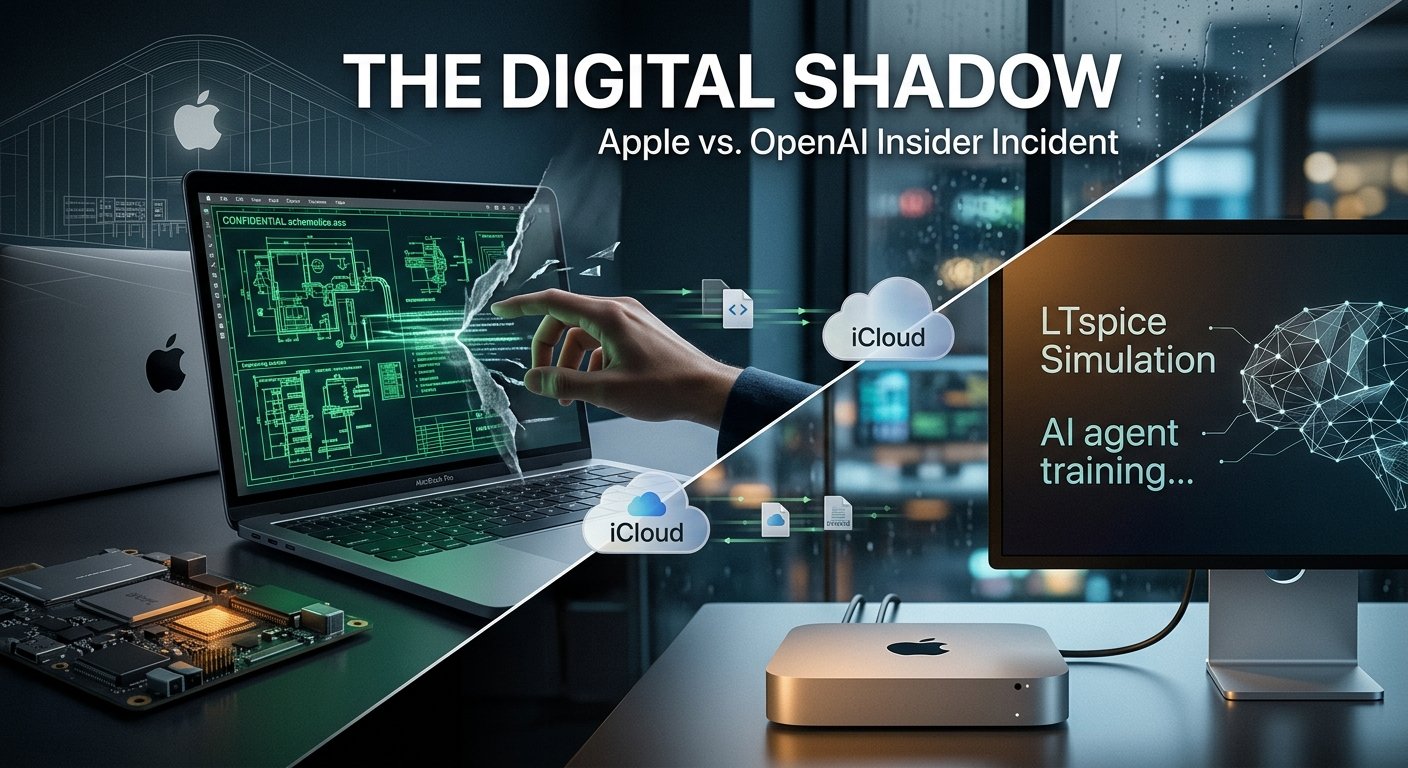
When corporate espionage transitions from cloak and dagger thrillers to federal court filings and forensic disk images, it rarely lacks drama. In late August 2026, Apple escalated its trade secrets litigation against OpenAI and former senior system electrical engineer Chang Liu, submitting what its legal counsel termed “shocking evidence” to the United States District Court for the Northern District of California.
The case presents a modern blueprint for insider risk. What began as a high-profile talent departure in January 2026 has transformed into a masterclass study in post-employment cloud access vulnerabilities, ambient endpoint synchronization, and the operational risks of training autonomous AI agents on stolen intellectual property.
Execution Mechanics: How the Compromise Occurred
According to supplemental briefs filed under Judge Edward J. Davila (Case 5:26-cv-07078), Apple’s forensic experts examined an Apple-issued MacBook surrendered by Liu’s counsel. The investigation revealed a systematic chain of unauthorized access, execution, and concealment:
- Post-Departure Cloud Access: Liu departed Apple for OpenAI in January 2026. However, on March 7, 2026, he leveraged active access to Apple’s third-party cloud infrastructure to download a confidential power-converter circuit schematic file along with simulation input data detailing operational modes.
- Local Execution and Simulation: On March 18, 2026, working under the user profile “changliu” on a personal Mac mini, Liu loaded the proprietary schematic into LTspice, a specialized software tool used by electrical engineers to model circuit behavior.
- Autonomous AI Training: Internal communications retrieved by forensic investigators quote Liu describing his daily routine at OpenAI, stating that he was “feeling AI all day long”. He explicitly noted that his custom AI agent “learned how to run LTspice, look at result, tune compensation parameter,” reducing a complex engineering task that previously required a full day down to just two hours.
- Cross-Device Cloud Synchronization: The LTspice simulation generated output files that automatically synchronized via personal iCloud accounts between the Mac mini and the Apple-issued MacBook in his possession. This ambient syncing mechanism inadvertently preserved the digital paper trail that forensic examiners later uncovered.
- Active Anti-Forensics and Spoliation: In June 2026, upon learning that Apple had launched an internal probe, messages show Liu contacting OpenAI colleague Yu-Ting Peng. He instructed her to have Apple-issued hardware restored to factory settings and then put back into regular use, a move Apple characterized in court as a deliberate tactic to overwrite system artifacts and erase forensic logs.
| Exfiltration Stage | Technical Mechanism | Operational Impact |
| Access | Legacy cloud credentials post-departure | Unmonitored retrieval of core circuit schematics |
| Processing | LTspice execution & AI agent automation | Proprietary IP embedded into AI model parameters |
| Bridge | Personal iCloud sync across endpoints | Data leakage outside enterprise perimeter |
| Concealment | Remote device factory resets | Overwriting of local system log artifacts |
Mitigation Frameworks: Preventing Modern Insider Threats
Defending against post-employment exfiltration, personal cloud bridging, and autonomous AI model contamination requires updating conventional perimeter controls:
- Automated Identity Revocation and Token Invalidation: Revoking primary Single Sign-On (SSO) accounts during offboarding is insufficient if legacy API keys, third-party cloud refresh tokens, and session cookies remain valid. Organizations should deploy Identity Threat Detection and Response (ITDR) platforms to ensure that employee termination automatically revokes all active OAuth tokens, SaaS access rights, and cloud bucket permissions across every connected service.
- Blocking Personal Cloud Intersects on Enterprise Endpoints: Personal cloud services like iCloud, Google Drive, or OneDrive create unmonitored pathways between corporate devices and personal hardware. Mobile Device Management (MDM) profiles must strictly block personal cloud account login, disable background cloud synchronization, and restrict unapproved local storage drivers on enterprise workstations.
- Data Guardrails for AI Workflows: Introducing trade secrets into an autonomous AI agent or machine learning pipeline poses a unique risk: the proprietary data can permanently inform model weights and operational workflows. Security teams should implement Data Loss Prevention (DLP) proxies in front of enterprise AI runtimes to inspect prompts, input files, and code attachments for sensitive file formats (such as .asc or .cad schematics) before processing.
- Immutable Forensics and Immediate Legal Holds: To defend against device wiping and factory resets, security architectures should maintain immutable, write-once cloud logs for network traffic and access events. When an employee departure or internal investigation is initiated, an automated security policy should immediately lock the device’s remote wipe capability and take cryptographically signed local snapshots.
Sources
- 9to5Mac: Apple reveals ‘shocking evidence’ from ex-employee’s MacBook in OpenAI suit
- MacRumors: Apple Says Former Engineer Used Stolen Trade Secrets at OpenAI
- Value Add VC: Apple OpenAI lawsuit: destroying evidence claim 2026
- Unite.AI: Apple Tells Court OpenAI Employee Used Confidential Circuit Schematic
- AI Weekly: Apple filing says ex-engineer used its schematic at OpenAI
For a visual breakdown of the forensic findings on the returned MacBook, you can watch Apple Says an AI Agent Ran Its Stolen Chip File. This video explains how court documents detailed the path of the LTspice file from Apple’s cloud to the AI agent.