For years, corporate security teams treated the “insider threat” as a human resources problem wrapped in a cybersecurity shell. The stereotypical threat actor was a disgruntled employee copying source code onto a thumb drive before storming out of the building.
But as we cross into June 2026, the landscape has fundamentally shifted. Fresh research and a wave of massive, high-profile cybersecurity incidents have revealed a stark reality. The traditional malicious employee is now eclipsed by the weaponization of compromised employee identities and the rapid adoption of ungoverned enterprise tools.
The user is no longer just operating within the perimeter because the user is the perimeter.
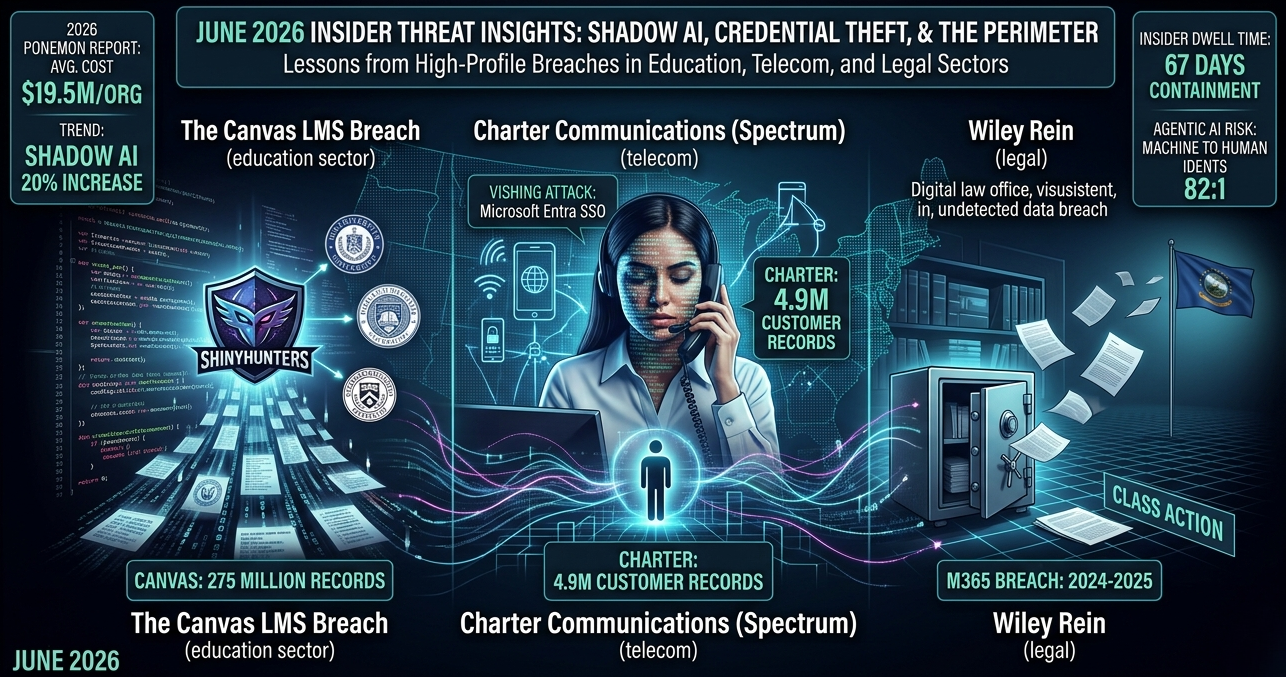
According to the newly released 2026 Ponemon Cost of Insider Risks Report, published by DTEX Systems, the average annual cost of dealing with insider incidents has climbed to a staggering $19.5 million per organization, up from $17.4 million just two years prior. While malicious actors command heavy headlines, human negligence and social engineering account for the vast majority of these losses.
By looking at the landmark breaches breaking across the headlines this month, spanning education, major telecommunications, and high-stakes legal sectors, we can map out exactly how modern insider risks manifest and what security leaders must do to contain them.
1. The Education Sector Shockwave: The Canvas LMS Breach
The education sector is currently reeling from what is being classified as one of the largest educational security breaches on record, according to documentation tracking public data breaches on Wikipedia.
Over the course of May and spilling directly into early June 2026, Instructure, the parent company behind the widely used Canvas Learning Management System (LMS), faced a cascading data security disaster. The platform handles coursework, communication, and grading for over 30 million active users globally, including roughly 41% of all higher-education institutions in North America.
The Vector of Failure
According to security update tracking documented by CSO Online, the initial breach began quietly in late April when threat actors exploited an identity-based vulnerability related to support tickets within the “Free for Teacher” environment of Canvas. This access allowed the extortion group known as ShinyHunters to exfiltrate an astonishing 3.65 terabytes of data, containing the personal records, student IDs, and private messages of roughly 275 million users.
The incident took an aggressive turn on May 7 and into early June. Despite initial claims of containment, users logging on to complete final examinations were greeted not by their dashboards, but by a defaced login screen featuring a ransomware notice from ShinyHunters. As noted by CSO Online, the timing was meticulously engineered to inflict maximum operational chaos during university finals week.
The Insider Dynamic
The Canvas breach emphasizes the risk of unmonitored account permissions within complex ecosystems. When an external adversary compromises an internal account system, even a free tier, they assume the trusted status of an insider. To the network, the malicious commands look like regular, authenticated user behavior, which explains why the intrusion remained unnoticed for days before the public defacement occurred.
2. Telecom Vulnerability: Charter Communications (Spectrum)
If the Canvas breach demonstrated the peril of account-vulnerability exploitation, the early June fallout at Charter Communications showcased the terrifying efficacy of human-centric social engineering.
Operating under the Spectrum brand, Charter is one of the largest broadband and mobile providers in the United States. In late May and early June, ShinyHunters struck again, listing Charter on its dark-web leak site after the telecom provider refused to pay an extortion demand, which is a development tracked by SafeState Security.
The Vishing Masterclass
What makes the Charter breach so alarming is the complete absence of sophisticated malware or zero-day software exploits. Reports from SafeState Security and Digital Forensics Magazine indicate that the threat actor gained access through a coordinated vishing (voice phishing) campaign.
An attacker placed a highly convincing phone call to an internal employee while impersonating IT support or an enterprise partner. The employee was manipulated into surrendering single sign-on (SSO) credentials for their Microsoft Entra account. Once the attacker had control of that identity, they seamlessly bypassed perimeter security, pivoted directly into Charter’s Salesforce CRM environment, and began exporting customer records at scale.
The Damage Contradiction
Independent security analyses published by PKWARE confirmed that roughly 4.9 million unique email addresses, alongside names, physical addresses, and internal employee directories, were leaked into the wild.
The lesson for security leaders here is profound: Identity-based controls are useless if the human holding the identity can be tricked into giving it up. As noted in SafeState’s threat intelligence brief, ShinyHunters has used this exact vishing playbook to target over 1,000 organizations using cloud infrastructure throughout 2026, successfully shifting their focus from corporate code to the corporate help desk.
3. The Legal Sector Dwell-Time Crisis: The Wiley Rein Class Action
The true depth of an insider breach is rarely understood when the initial hack occurs. It often takes months, or even years, to fully unravel. This reality was put on full display in late May and early June 2026, when a major class-action lawsuit was officially filed in Washington, D.C., against the prominent law firm Wiley Rein, as reported by The True Story News and Digital Forensics Magazine.
A Quiet Year of Spying
Wiley Rein, which represents major Fortune 500 companies and critical political clients navigating complex geopolitical and trade waters, was targeted in a highly sophisticated, long-term espionage campaign linked to foreign state-sponsored actors.
The legal complaint details that hackers successfully compromised internal Microsoft 365 email accounts belonging to firm personnel. The horrifying detail is the timeline: the actors maintained persistent, undetected access to these internal mailboxes from July 2024 all the way through June 2025.
The Cost of Failed Detection
The lawsuit alleges that the firm failed to implement adequate multi-factor authentication (MFA), lacked baseline staff training, and mismanaged evidence preservation.
This incident illustrates the concept of “dwell time” in insider risk. When an external actor operates using valid, hijacked internal email credentials, their footprints match the baseline behavior of legitimate employees. Without behavioral analytics that flag anomalies, such as an account accessing sensitive trade data at odd hours or from unusual locations, these hidden spies can read corporate strategies entirely unhindered.
The Macro Trends of 2026: What the Numbers Tell Us
When we zoom out from these individual corporate disasters, the macro data paints a clear picture of why security strategies must pivot. Data compiled across the industry by security firms like SentinelOne highlights the changing economics of insider risk:
- The Shadow AI Boom: The uncontrolled usage of Generative AI has introduced an entirely new tier of negligence. Employees looking to automate tasks are pasting proprietary source code, financial spreadsheets, and customer data into public AI models. SentinelOne reports a 20% increase in insider threat costs over the last two years, fueled heavily by this “Shadow AI” data leakage.
- The Identity Explosion: According to SentinelOne’s enterprise risk telemetry, the ratio of machine and AI identities, such as automated scripts, APIs, and AI agents, to human employees has now reached an astonishing 82 to 1. Managing insider risk is no longer just about tracking human employees because it now requires governing the automated workflows those employees set up.
- The Financial Service Premium: While healthcare remains incredibly vulnerable due to the value of medical records, the financial services sector pays the highest price tag for insider failures, averaging an annual cost of $20.68 million per organization to remediate insider vulnerabilities.
The Silver Lining: Velocity Matters
It isn’t all bad news. The 2026 SentinelOne global data shows that organizations heavily investing in behavioral intelligence and dedicated insider risk management programs have successfully dropped their average incident containment time to 67 days.
The financial incentive for speed is massive. An insider incident contained within 30 days incurs an average annual overhead of $14.2 million, whereas letting that same threat linger past 90 days causes costs to balloon to $21.9 million.
Action Plan for Security Leaders
The incidents at Canvas, Charter, and Wiley Rein prove that yesterday’s security stack is insufficient for today’s identity-centric threats. To protect corporate ecosystems, organizations must implement three core changes:
- Transition from Identity Verification to Behavioral Context: Simply checking if a user has the right password or MFA token is no longer enough. Security systems must actively monitor what the user does after logging in. If a customer support representative suddenly attempts to export millions of records from Salesforce, the system must autonomously halt the action.
- Govern the AI Workspace: Implement strict discovery and monitoring tools to bridge the “AI visibility gap.” Organizations must treat autonomous AI agents and public LLM prompts with the same strict data-loss prevention (DLP) standards applied to external email attachments, which is a mitigation strategy heavily emphasized in the DTEX Ponemon report.
- Harden the Human Help Desk: Since groups like ShinyHunters are aggressively bypassing technical perimeters via vishing, employee awareness training must extend beyond basic email phishing. As suggested by SafeState’s post-incident response guide, voice authentication protocols and out-of-band verification steps must be mandatory before IT help desks reset credentials or modify system access.
The high-profile breaches of June 2026 serve as a stark reminder that unverified trust is a vulnerability. True resilience lies in an organization’s ability to make every internal identity observable, attributable, and governable.
Sources & Further Reading
- Wikipedia: 2026 Canvas Data Breach
- CSO Online: Lessons from the Canvas Cyberattack
- SafeState Security: Charter Communications Data Breach Exposes 42 Million Records
- PKWARE: 2026 Data Breaches & Cybersecurity Incidents
- Digital Forensics Magazine: Global Threat Roundup
- The True Story News: Wiley Rein Legal Sector Breaches
- SentinelOne: Insider Threat Statistics and Trends for 2026
- DTEX Systems: Ponemon Cost of Insider Risks Report 2026