The fundamental anatomy of an insider threat remains unchanged. It still relies on a trusted identity, a set of credentials, and either malicious or negligent intent. However, the velocity of execution and the sheer scale of the digital attack surface have completely shifted.
Before the rapid adoption of Generative AI, an insider attempting data exfiltration had to plan. They downloaded files, plugged in unencrypted USB drives, or staged data in unauthorized cloud accounts. These activities were easily flagged by traditional Data Loss Prevention platforms.
In the modern enterprise, the timeline from intent to impact has shrunk from weeks to minutes. Insiders are no longer just exfiltrating structured files. They are feeding proprietary data directly into external Large Language Models, using autonomous agents to discover high-value assets, and even infiltrating organizations using synthetic, AI-generated identities.
This is no longer an emerging risk. According to research from the Gurucul Insider Risk Management Consortium, ninety-four percent of organizations state that AI adoption is directly increasing their insider risk exposure. Furthermore, forty-five percent of organizations now explicitly classify AI copilots and generative AI tools as a core insider risk.
To protect enterprise data, security teams must move away from static, perimeter-focused detection and rebuild their strategies around dynamic behavioral telemetry.
Why Legacy Defense Models Break Under AI
Traditional insider threat programs were built around three core profiles: the malicious insider acting out of grievance or greed, the negligent insider whose carelessness creates openings, and the compromised insider whose credentials have been stolen.
Artificial intelligence does not fit cleanly into any of these buckets, yet it amplifies the blast radius of all three.
For the negligent insider, AI dramatically increases the scale of accidental exposure. An employee who once might have emailed a sensitive spreadsheet to the wrong recipient can now inadvertently feed entire proprietary codebases, customer records, or financial models into public generative AI tools to write a quick report.
The data exfiltration is rarely malicious in these scenarios. Rather, it is a byproduct of employees trying to work faster and improve their output. According to data from the Verizon Data Breach Investigations Report, up to fifteen percent of employees routinely access generative AI systems from corporate devices, and seventy-two percent of those users use non-corporate, unmonitored personal emails as their account identifiers.
For the malicious insider, AI acts as a sophisticated tutor. It lowers the technical barrier to execution. Actions that once required deep scripting knowledge or advanced network familiarity can now be guided step by step by an AI assistant. An employee can ask an LLM how to write a stealthy data-harvesting script, how to bypass a specific endpoint detection and response agent, or how to format an unauthorized data transfer to look like standard web traffic.
For the compromised insider, AI introduces complex external attack vectors. Threat actors can use prompt injection techniques to trick integrated enterprise AI systems into retrieving and disclosing sensitive workflows, bypassing the access boundaries that would normally restrict the legitimate user.
The New Attack Vectors: Traditional vs. AI-Era
To secure an enterprise from the inside, security architectures must evolve to recognize how these classic threat vectors have been augmented by modern machine intelligence.
| Threat Vector | Traditional Method | AI-Era Method | The Detection Blind Spot |
| Data Exfiltration | Large file transfers via SFTP, personal cloud storage, or USB mass storage devices. | Semantic exfiltration, copying and pasting raw text blocks or proprietary code into public LLMs. | Standard Data Loss Prevention tools block specific file types, but struggle to identify raw, unformatted text blocks pasted into HTTPS browser sessions. |
| Reconnaissance | Manual SQL queries, network port scanning, and active lateral movement mapping. | Deploying local, autonomous AI agents to parse system directory structures and map high-value targets at machine speed. | Endpoint detection systems often fail to recognize autonomous agents because the activity occurs under legitimate, high-privileged user sessions. |
| Onboarding Fraud | Fabricated resumes, exaggerated credentials, and falsified certifications. | Synthetic identities created with highly convincing AI-generated deepfakes and tailored persona histories. | Standard background checks and digital identity verification platforms struggle to detect sophisticated synthetic visual and behavioral patterns. |
Three Critical Signals to Monitor
If your threat hunting team relies solely on static rules, such as alerting when an employee downloads more than five gigabytes of data, your organization remains highly vulnerable. Modern insider threat detection requires real-time monitoring across three distinct dimensions.
1. Semantic Data Leakage (Prompt-Level DLP)
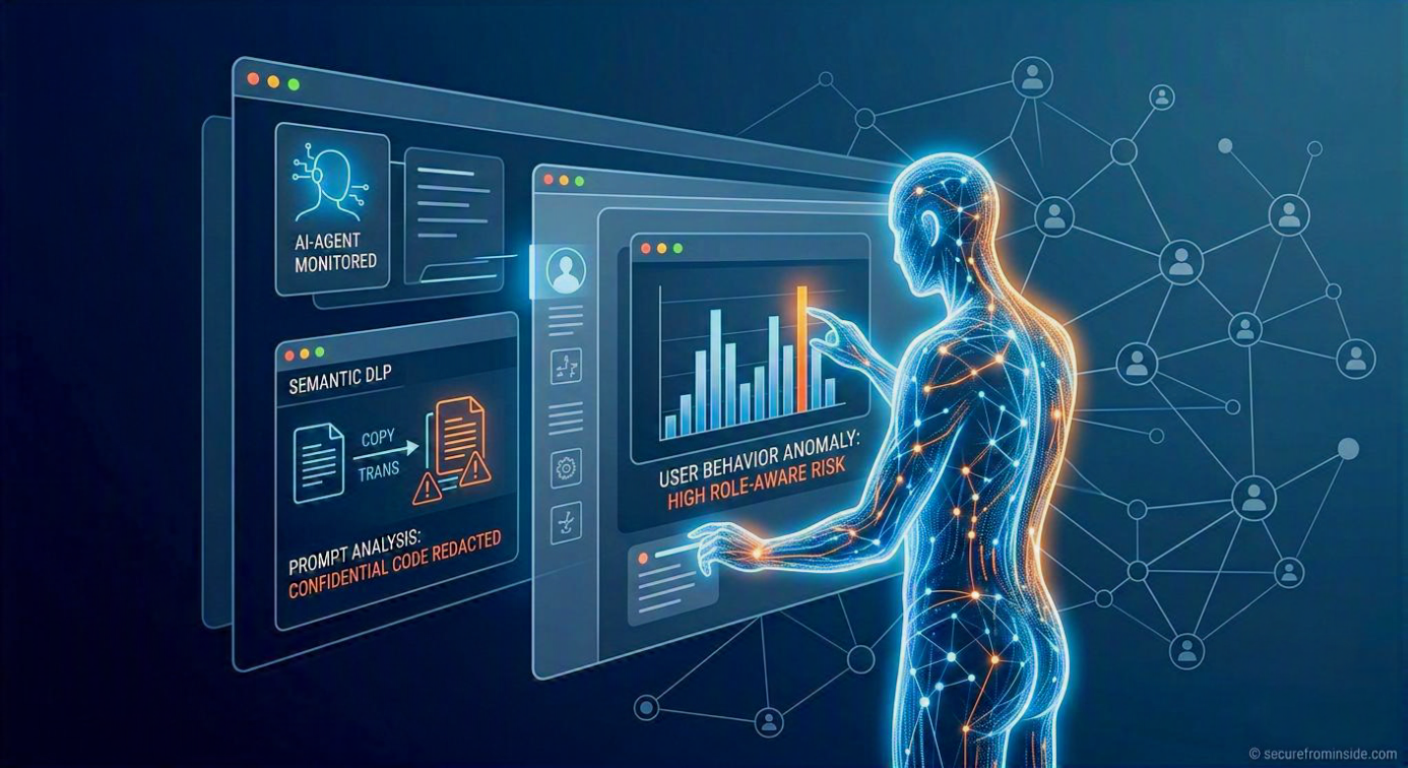
Employees copying and pasting sensitive data into unauthorized AI browser extensions or public chatbots is the fastest-growing source of accidental data exposure. Security teams must monitor outgoing HTTPS payloads directed to known generative AI domains.
Instead of relying on basic keyword matching, organizations should employ api-level gateways. These gateways use localized, lightweight natural language processing models to perform semantic analysis on outbound prompts before they leave the network perimeter. The system must scan conversational prose to identify and block structural data, including database schemas, application programming interface keys, and proprietary source code.
2. Role-Aware Behavior (Next-Gen UEBA)
Static baselines do not work in dynamic development or operational environments. If a software engineer queries an AI coding assistant dozens of times a day, the behavior is normal. However, if a member of the human resources department or finance team suddenly begins making API calls to an external development environment, the system should trigger an immediate investigation.
Security programs must implement unsupervised machine learning models that analyze behavior relative to a user’s peer group, rather than applying uniform, rigid policies across the entire company directory.
3. Non-Human Identity Drift
With the rapid deployment of agentic AI workflows, non-human identities are now executing complex tasks on behalf of employees. These autonomous systems often operate with broad, unmanaged permissions.
Security architectures must establish strict behavioral boundaries for non-human service accounts. If an AI agent attempts to read directories outside of its designated workspace or tries to transfer data to an external API endpoint without documentation, the identity must be flagged and isolated immediately.
Architectural Roadmap for the Modern Enterprise
Updating your insider threat program requires shifting from reactive blocking to continuous, proactive behavioral analysis. Security leaders can implement this modernization using a structured, four-phase approach.
1.Map the AI Data Landscape:
Phase 1.
Audit the organization to discover all authorized and shadow AI tools. Establish clear classification policies detailing exactly what types of intellectual property, client records, and corporate data are allowed to interact with these systems.
2.Deploy Prompt-Level Gateways:
Phase 2.
Route all outgoing generative AI traffic through centralized, API-enabled secure gateways. Use natural language processing filters to inspect the context of user prompts in real-time, stripping away sensitive metadata and proprietary content before transmission.
3.Rebuild Behavioral Baselines:
Phase 3.
Transition User and Entity Behavior Analytics tools away from basic volume-based alerts. Feed the analytics engine authentication records, cloud SaaS logs, and endpoint telemetry to establish dynamic, peer-group behavioral baselines.
4.Enforce Just-In-Time Permissions:
Phase 4.
Treat all autonomous AI agents as distinct machine identities. Restrict their access using cryptographic, non-shared credentials and strictly enforce the principle of least privilege across all automated integration layers.
The Security Architect’s Reality: Technology changes, but the human element remains constant. Artificial intelligence is a powerful force multiplier for both the defender and the threat actor. Securing the modern enterprise requires visibility. By focusing on behavioral context, implementing strict identity hygiene, and monitoring how data moves through AI pipelines, organizations can successfully mitigate insider risk at machine speed.
Referenced Sources
- SentinelOne: Global Insider Threat Statistics and Analysis
https://www.sentinelone.com/cybersecurity-101/cybersecurity/insider-threat-statistics
- Swif.ai: Cost of Insider Risks and Emerging Security Trends
https://www.swif.ai/blog/insider-threat-statistics
- Forcepoint: Detecting Risks and Data Exposure in AI Workflows
https://www.forcepoint.com/blog/insights/ai-insider-threat
- Darktrace: How Generative AI Changes the Insider Threat Landscape
https://www.darktrace.com/blog/ai-insider-threats-how-generative-ai-is-changing-insider-risk
- Gurucul: Industry Research on AI Adoption and Insider Risk Exposure
- https://gurucul.com/press-releases/gurucul-research-demonstrates-ai-is-the-new-insider-threat-as-90-of-organizations-experience-incidents/