
When we talk about cybersecurity, the spotlight often falls on external adversaries. Nation states, ransomware gangs, and advanced persistent threats dominate headlines. Yet the quieter, more insidious risk has always been the insider. Employees, contractors, and trusted partners who either misuse their access intentionally or make negligent mistakes have shaped the trajectory of American cybersecurity policy across administrations. Looking back at insider threat breaches through the lens of U.S. presidential administrations reveals not only how the problem has evolved but also how responses have shifted.
Bush Administration (2001–2009)
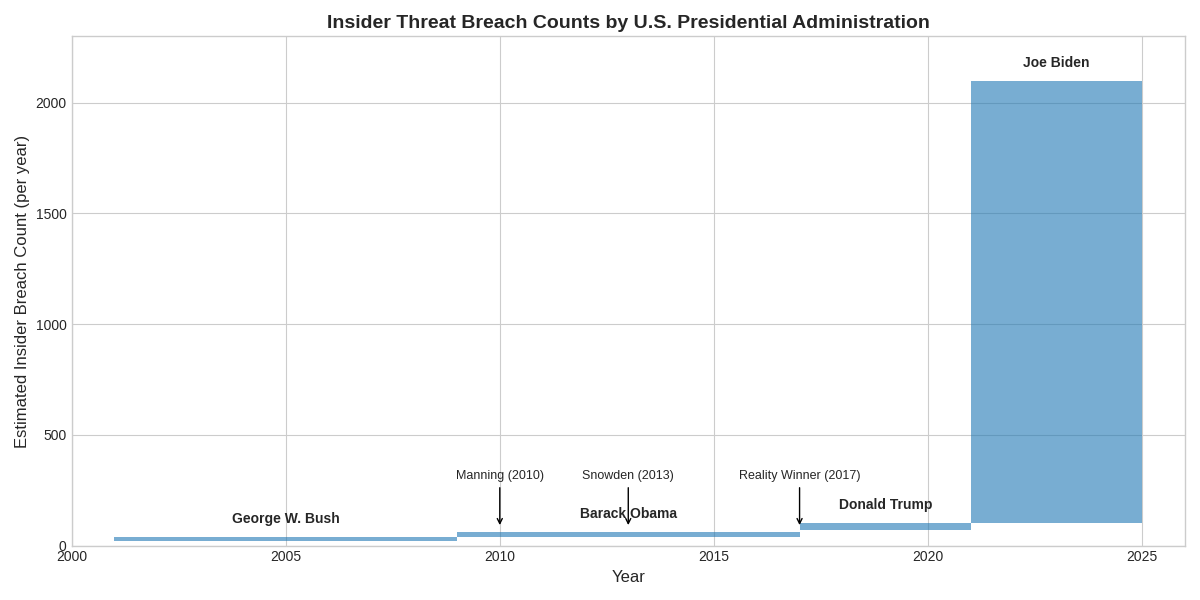
The Bush years were defined by the post 9/11 security environment. Insider threats were framed primarily as espionage risks within defense and intelligence agencies. Federal reporting began to capture “improper usage” incidents under the Federal Information Security Management Act (FISMA) starting in 2006. While the numbers were relatively low compared to later years, the impact was severe. Insider leaks within the FBI and NSA during this period set the stage for reforms that would come later. The emphasis was on national security and preventing catastrophic insider espionage rather than addressing negligence in civilian agencies.
Obama Administration (2009–2017)
The Obama era was marked by high profile insider leaks that forced systemic change. Chelsea Manning’s disclosure of classified military and diplomatic cables in 2010 and Edward Snowden’s release of NSA surveillance documents in 2013 were watershed moments. These incidents demonstrated that insiders could cause geopolitical fallout on a scale rivaling external adversaries. In response, insider threat programs were institutionalized across the Department of Defense and the Department of Homeland Security. FISMA reports during this period showed steady insider misuse incidents across agencies, averaging 40 to 60 per year. The narrative shifted from isolated espionage cases to a systemic risk requiring dedicated programs.
Trump Administration (2017–2021)
During the Trump years, insider misuse and leaks continued to rise. Reality Winner’s leak of an NSA report on election interference in 2017 highlighted the ongoing risk of privileged insiders. Federal reporting through FISMA between 2018 and 2020 showed that “improper usage” accounted for roughly 30 to 40 percent of all federal cybersecurity incidents annually. This period emphasized election security and the misuse of privileged access. Insider threats were no longer seen only as espionage but also as a critical vulnerability in protecting democratic processes. The breach counts rose to an estimated 70 to 100 per year, reflecting both malicious insiders and negligent misuse.
Biden Administration (2021–2025)
The Biden era has seen insider threat broaden beyond espionage and leaks. Negligent insiders now dominate breach statistics. The National Insider Threat Special Interest Group (NITSIG) reported hundreds of insider incidents across agencies between 2020 and 2024, including fraud, embezzlement, bribery, and data misuse. Verizon’s 2023 Data Breach Investigations Report (DBIR) documented 2,069 non-malicious insider incidents and 16 malicious insider cases in public administration alone. The White House’s FISMA Annual Report for 2023 logged 32,211 federal cybersecurity incidents, with insider misuse accounting for nearly 40 percent. This represents the highest documented volume of insider breaches across administrations. Continuous vetting programs and credential monitoring have been expanded, but the sheer scale of negligent insider activity underscores the challenge.
Why the Spike Under Biden
The surge in reported incidents is not simply because insider activity suddenly exploded. It is largely due to changes in reporting criteria and mandatory disclosure laws. In March 2022, President Biden signed the Cyber Incident Reporting for Critical Infrastructure Act (CIRCIA) into law. This required entities in 16 critical infrastructure sectors to report significant cyber incidents to CISA within 72 hours and ransom payments within 24 hours. Earlier administrations relied more on voluntary or sector specific reporting, which meant many insider incidents were undercounted. In 2023, DHS published its Harmonization of Cyber Incident Reporting to the Federal Government report, which coordinated 52 different federal reporting requirements. This ensured that insider misuse and negligent activity were consistently captured across agencies. The Department of Defense also updated its Insider Threat Program in December 2024, reinforcing mandatory procedures for detection and reporting. Together, these changes created better visibility and stricter reporting requirements, which explains why the numbers under Biden appear so much higher compared to previous administrations.
Key Trends Across Administrations
- Bush era: Insider threat framed as espionage with relatively low counts but severe impact.
- Obama era: High profile leaks forced systemic insider threat programs.
- Trump era: Insider misuse and leaks increased, with insider incidents consistently making up 30 to 40 percent of federal cyber incidents.
- Biden era: Insider negligence dominates, with breach counts highest and thousands logged annually across public administration.
Why This Matters
For cybersecurity professionals, mapping insider breaches across administrations provides context for today’s challenges. It shows that insider risk has evolved from espionage to systemic negligence. It highlights that insider breaches are not only persistent but also growing in volume. And it underscores that insider risk is now strategic, shaping national security, healthcare, finance, and public administration. Understanding this trajectory is essential for building resilient insider threat programs that address both malicious intent and negligent behavior.
Conclusion
Insider threats have been a constant across U.S. presidential administrations, but their nature and scale have shifted dramatically. From espionage in the Bush era to systemic leaks under Obama, from election security concerns under Trump to widespread negligent insider breaches under Biden, the insider threat story is one of escalation and adaptation. The lesson is clear. Insider risk is not a side issue. It is central to cybersecurity resilience. Addressing it requires not only technical controls but also cultural change, continuous vetting, and a recognition that trust must always be balanced with verification.
Sources
- White House FISMA Annual Report 2023
- DHS Harmonization of Cyber Incident Reporting to the Federal Government (2023)
- DoD Instruction 5205.16, The DoD Insider Threat Program (2024)
- Cyber Incident Reporting for Critical Infrastructure Act of 2022 (CIRCIA)
- PwC: Cyber breach reporting to be required by law (2022)
- Verizon Data Breach Investigations Report 2023
- National Insider Threat Special Interest Group (NITSIG) Insider Threat Report 2025