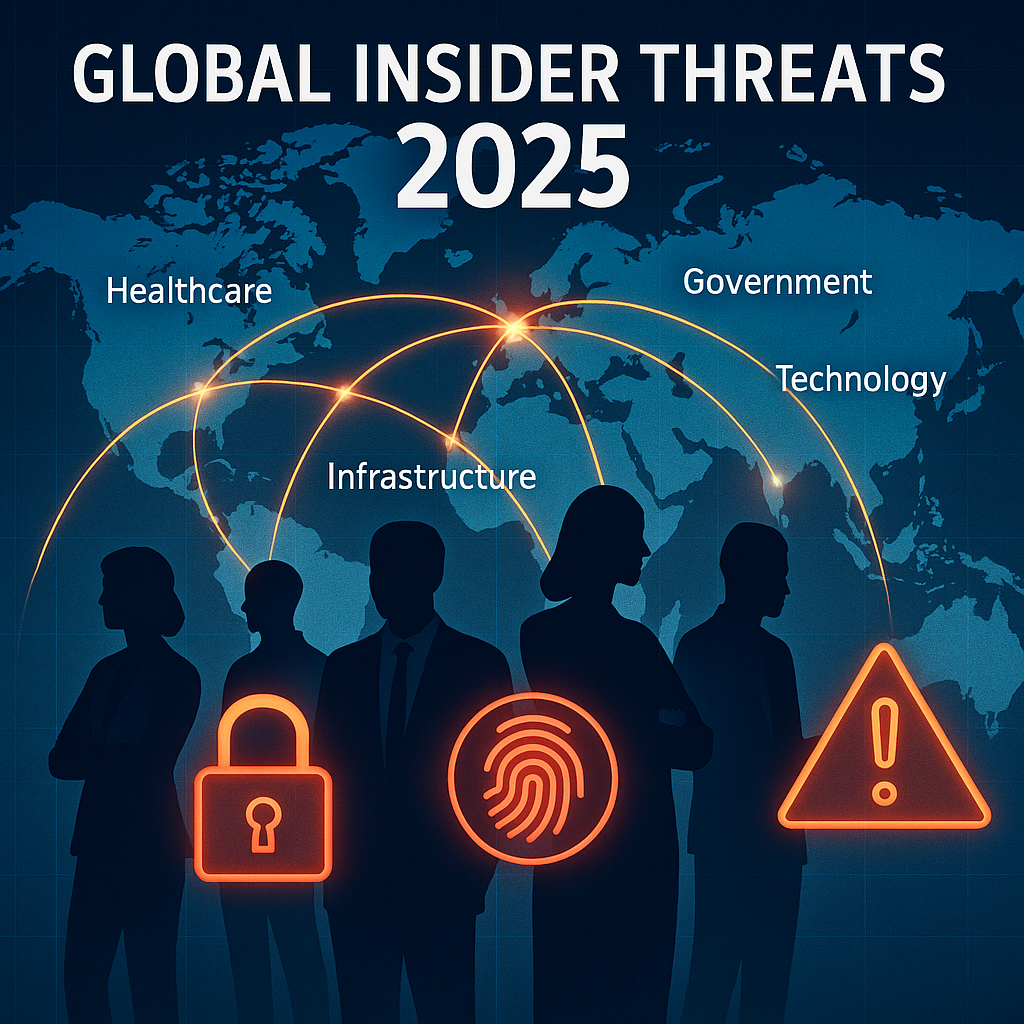
Insider threats surged to record levels in 2025, forcing organizations to rethink cybersecurity and risk management. Whether through negligence, malice, or compromised credentials, insiders caused billions in losses and exposed critical vulnerabilities. This analysis synthesizes findings from the Ponemon Institute 2025 Cost of Insider Risks Global Report, NITSIG Insider Threat Defense Group Reports, IBM Cost of a Data Breach 2025, Deloitte Cybersecurity Trends 2025, Fortinet Insider Risk Report 2025, and other leading sources.
The Scope of Insider Threats
- The global cost of insider incidents exceeded $17.4 billion (Ponemon Institute 2025).
- 83 percent of organizations experienced at least one insider attack (Fortinet 2025).
- The average annual cost per organization reached $17.4 million (Ponemon Institute 2025).
- North America led with the highest average cost at $22.2 million per organization (IBM 2025).
- Containment time matters: Incidents resolved within 31 days cost $10.6 million, while those lingering beyond 91 days averaged $18.7 million (Ponemon Institute 2025).
Why Are Insider Threats Rising?
Hybrid work and cloud adoption have expanded the attack surface (Deloitte 2025). Generative AI is both a tool for defenders and a weapon for attackers (SpyCloud 2025). Supply chain and third-party risks are more acute, with attackers targeting vendors and partners (NITSIG 2025).
Sectoral Breakdown: Incidents and Impact
Below is a screen-friendly table summarizing the number of incidents and estimated financial impact by sector:
| Sector | Incidents | Estimated Cost (USD) |
| Healthcare | 38 | $14.6B+ |
| Finance/Banking | 35 | $152.7M+ |
| Government | 33 | $56.7M+ |
| Technology/Software | 18 | $855M+ |
| Law Enforcement/Prisons | 12 | $662K+ |
| Employee Theft/Embezz. | 12 | $2.1M+ |
| Trade Secret/Data Theft | 10 | $69M+ |
| Defense/Intelligence | 9 | $4.9M+ |
| Education/Research | 8 | $3.8M+ |
| Critical Infrastructure | 7 | $56.4M+ |
| Employee Collusion | 4 | $528K+ |
(Data aggregated from Ponemon Institute 2025, NITSIG 2025, IBM 2025, Fortinet 2025.)
Expanded Sector Analysis
Healthcare faced the most severe insider threats, with mega-breaches, fraud, and regulatory penalties. The National Health Care Fraud Takedown involved over $14.6 billion in intended losses, exposing systemic weaknesses in billing and oversight (NITSIG 2025). The average cost of a healthcare data breach in the U.S. reached $10.22 million, the highest of any industry for the 14th consecutive year (IBM 2025).
Finance and Banking institutions were prime targets for malicious insiders and credential compromise. Notable cases included a $140 million theft from Brazilian banks enabled by an insider selling credentials, and multi-million-dollar embezzlement schemes in the U.S. Annualized cost per organization exceeded $20 million, with credential theft and privilege misuse as dominant vectors (Ponemon Institute 2025).
Government and Defense agencies experienced a high volume of insider incidents, including embezzlement, bribery, espionage, and fraud. High-profile cases included a county treasurer embezzling $38.7 million and defense contractors leaking classified information. Regulatory fines and operational disruption added to the sector’s burden (NITSIG 2025).
Technology and Software was hit by trade secret theft, credential compromise, and insider-enabled data breaches. Incidents included a $452 million trade secret verdict (Insulet), a $400 million breach at Coinbase via bribed employees, and a Tesla engineer stealing proprietary data. High-value intellectual property and rapid workforce turnover increased risk (Deloitte 2025).
Critical Infrastructure providers faced insider-enabled sabotage, fraud, and credential compromise. Notable incidents included a $2.4 million fraud at a water utility and supply chain attacks exploiting third-party access. Reliance on contractors and legacy systems compounded risk (Ponemon Institute 2025).
Education and Research institutions reported a high percentage of breaches involving insiders, often driven by negligence or financial pressure. Incidents included multi-million dollar fraud schemes, embezzlement, and unauthorized data access (SpyCloud 2025).
Threat Typology and Financial Impact
- Negligent insiders accounted for 55 percent of incidents, with an average annual cost of $8.8 million (Ponemon Institute 2025).
- Malicious insiders were responsible for 25 percent of incidents, with the highest average cost per incident at $715,366 (Ponemon Institute 2025).
- Compromised credentials accounted for 20 percent of incidents and were the costliest on a per-incident basis at $779,797 per event (SpyCloud 2025).
Clarification: While malicious insiders caused the highest total cost across all incidents, incidents involving compromised credentials had the highest average cost per event.
Containment time is critical: Incidents contained within 31 days averaged $10.6 million, while those exceeding 91 days averaged $18.7 million (Ponemon Institute 2025).
Notable Incidents of 2025
- In healthcare, a $14.6 billion fraud takedown involved 324 defendants (NITSIG 2025).
- In finance, an insider sold credentials enabling $140 million theft from Brazilian banks (Ponemon Institute 2025).
- In technology, Coinbase suffered a breach via bribed employees, and a Tesla engineer stole proprietary data (Deloitte 2025).
- In government, a county treasurer embezzled $38.7 million (NITSIG 2025).
- In critical infrastructure, a $2.4 million fraud occurred at a water utility (Ponemon Institute 2025).
Trends and Patterns
- Credential theft and privilege misuse are top attack vectors (SpyCloud 2025).
- AI and automation are double-edged swords: adversaries use AI for phishing, defenders for detection (Deloitte 2025).
- Supply chain and third-party risks are rising, with attackers exploiting vendor access and SaaS ecosystems (NITSIG 2025).
- Regulatory scrutiny is intensifying, with HIPAA, GDPR, and sector-specific mandates requiring rapid breach notification and risk analysis (IBM 2025).
Best Practices for 2026 and Beyond
Identity-First Security: Move beyond perimeter defenses. Focus on identity, behavior, and context to detect threats early (Ponemon Institute 2025).
Zero Trust Architecture: Assume breach. No user or device should be trusted by default; continuous verification and micro-segmentation limit lateral movement (Deloitte 2025).
AI-Driven Detection: Organizations using AI and automation in their security programs saved an average of $1.9 million per breach and shortened breach lifecycles by 80 days (IBM 2025).
Vendor Risk Management: Continuous monitoring of vendors and contractual security requirements are essential. Annual assessments are no longer sufficient; real-time visibility into third-party security postures is required (NITSIG 2025).
Continuous Improvement and Collaboration: Adopt and contribute to standards like IIDES to improve data sharing and analysis. Collaborate with industry groups to share threat intelligence and best practices (Carnegie Mellon SEI 2025).
Addressing Human Factors: Foster a positive security culture. Encourage reporting of suspicious activity without fear of reprisal. Monitor for behavioral red flags using both technical and human-centric indicators (Fortinet 2025).
Conclusion
The insider threat landscape in 2025 was defined by escalating frequency, rising costs, and increasing complexity. While negligence remains the most common cause, the financial and operational impact of malicious insiders and credential compromise is growing. Healthcare, finance, government, and technology sectors bore the brunt of losses, but no industry was immune. The convergence of hybrid work, cloud adoption, and AI has expanded the attack surface, while supply chain and third-party risks demand new approaches to risk management.
Organizations that invested in proactive, behavior-aware insider risk management—integrating AI-driven detection, cross-functional governance, and continuous training—were better positioned to detect and contain incidents early, saving time, money, and reputational damage. As the threat landscape continues to evolve, a shift toward identity-first, zero trust security, continuous monitoring, and industry-wide collaboration will be essential to mitigate the risks posed by insiders in 2026 and beyond.
Sources
- https://www.ponemon.org/library/2025-cost-of-insider-risks-global-report
- https://www.nitsig.org/insider-threat-defense-group-reports
- https://www.ibm.com/reports/data-breach-2025
- https://www2.deloitte.com/global/en/pages/risk/articles/cybersecurity-trends.html
- https://www.fortinet.com/resources/cybersecurity-insider-risk-report
- https://resources.sei.cmu.edu/library/asset-view.cfm?assetid=653842
- https://spycloud.com/insider-threat-pulse-report-2025/