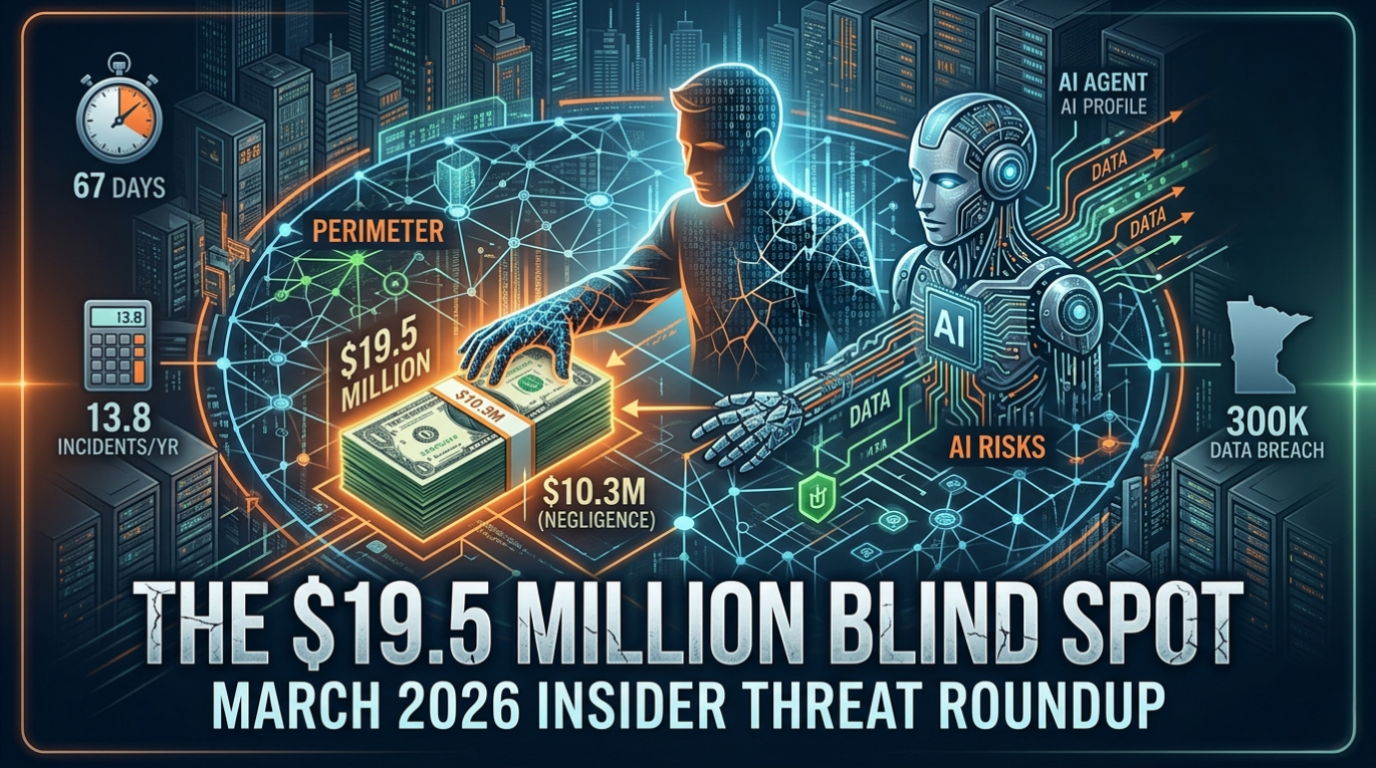
The last 30 days have been a watershed moment for the “insider” definition. New data is showing that the financial stakes have never been higher. At the same time, we are witnessing the birth of an entirely new category of risk.
Here are the critical insider threat trends and incidents from March 2026 that you can’t afford to ignore.
1. The Paradigm Shift: AI Is Now Your Newest “Employee”
This is the biggest narrative change in years. We are officially moving away from treating Artificial Intelligence as just a “tool.” Industry frameworks are now transitioning to treating AI agents as digital employees with their own set of insider risks.
According to predictions from Menlo Security (Predictions for 2026: Why AI Agents Are the New Insider Threat), attackers are using techniques like prompt injection to turn trusted internal AI agents against their own companies. If an agent has access to restricted data like your OneDrive, Google Drive, or Salesforce, it can be manipulated into exfiltrating that information at a massive scale.
Furthermore, a staggering 94% of organizations in recent surveys (as reported in the 2026 Cost of Insider Risks Global Report) explicitly state that AI adoption has increased their insider risk exposure. We are also seeing a surge in “orphaned” AI agents: autonomous tools created for short-term projects and then abandoned, leaving high privilege access tokens active and entirely unmonitored.
2. Skyrocketing Costs and the Price of Negligence
If you thought the cost of an insider incident was manageable, think again. The 2026 Cost of Insider Risks Global Report (conducted by the Ponemon Institute and DTEX), released in late February, reveals that the annualized stakes for a large enterprise have jumped to $19.5 million per year.
Here’s where it gets surprising: the primary cost driver isn’t the disgruntled employee trying to sell secrets. It’s negligence.
- Negligent or mistaken insiders account for 53% of the total financial impact. This costs organizations an average of $10.3 million annually.
- These aren’t rare events, either. Organizations are now averaging 13.8 incidents per year.
The report also shows that time is your greatest enemy. It still takes an average of 67 days to contain an insider event. If containment drags on past 90 days, your annual cost can jump to $21.9 million.
3. Real World Incidents: From Excess Access to Global Disruption
The last month has given us vivid examples of how these risks manifest in the real world. These aren’t hypothetical scenarios. They are actionable case studies.
The Minnesota Data Breach (Role Based Access Failure)
In March 2026, details emerged regarding a significant data breach in Minnesota (Minnesota Human Services Data Breach May Affect 300K People, GovTech). Personal data for nearly 300,000 people was exposed.
The root cause was identified as excessive internal access. An employee, associated with a licensed provider, was authorized to access limited information in the state system but accessed more data than was reasonably necessary for their specific work assignments. The user accessed sensitive details, including names, Medicaid IDs, and partial Social Security numbers, spanning a time period of late August to September 2025. This incident underscores why classic Role Based Access Control (RBAC) is failing in complex, distributed environments.
The Stryker Global Disruption (The Identity Based Attack)
On March 11, 2026, the medical technology firm Stryker was hit by a major operational disruption affecting its global Microsoft environment (Medical technology company Stryker disrupted globally by cyberattack, AHA News). Employees on three continents reported seeing their devices factory reset in real time (The Stryker Story: When Device Management Platform Becomes a Weapon, Guardz.com).
While Stryker stated there was no indication of ransomware or traditional malware, the incident was far from benign. The attack involved a compromise of identity based access. Reports indicated the threat actor group, Handala, claimed responsibility and alleged they gained access to Stryker’s administrative tools, such as the Microsoft Intune console, to issue mass remote wipes of over 200,000 servers, laptops, and mobile devices across 79 countries. By compromising the “insider level” permissions of a trusted administrator, the attackers were able to bypass endpoint detection entirely.
The “Zestix” Brokerage (industrializing Insider Access)
The blurring line between external and internal threats is being industrialized on the dark web. Monitoring has identified a surge in “Initial Access Brokers” (IABs) like Zestix, who actively build a business model around buying credentials from disgruntled or negligent employees (MFA Failure Enables Infostealer Breach At 50 Enterprises, Infosecurity Magazine).
Zestix doesn’t use sophisticated exploits. They log directly into corporate cloud systems like ShareFile, OwnCloud, and Nextcloud using valid credentials, often stolen from an employee’s infected personal device. These brokers then sell this “verified insider access” to ransomware groups, facilitating major enterprise breaches without needing a single zero-day exploit.
Conclusion: Securing the Human Plane
The defining lesson of March 2026 is that the “perimeter” is no longer just a firewall. It is the identity of every employee, contractor, and autonomous AI agent in your network.
When negligence is costing organizations $10.3 million annually, your security awareness training is no longer a checklist item. It is a critical component of your risk management strategy. Furthermore, as the average time to move from initial access to lateral movement has plummeted to 29 minutes (2026 CrowdStrike Global Threat Report), your ability to detect compromised “insider” behavior in real time is no longer luxury. It is a necessity.
We are no longer just securing a network. We are securing the human plane.
Sources Cited:
- Ampcus Cyber: Zestix Exploited Infostealer Logs to Breach Global Firms. https://www.ampcuscyber.com/shadowopsintel/zestix-exploited-infostealer-logs-to-breach-global-firms/
- CrowdStrike: 2026 Global Threat Report. [Link would go here]
- DTEX: 2026 Cost of Insider Risks Global Report. https://ponemon.dtex.ai/
- GovTech: Minnesota Human Services Data Breach May Affect 300K People. https://www.govtech.com/security/minnesota-human-services-data-breach-may-effect-300k-people
- Guardz.com: The Stryker Story: When Device Management Platform Becomes a Weapon. https://guardz.com/blog/the-stryker-story-when-device-management-platform-becomes-a-weapon/
- Help Net Security: The $19.5 million insider risk problem. https://www.helpnetsecurity.com/2026/02/26/insider-risk-costs-2026/
- Infosecurity Magazine: MFA Failure Enables Infostealer Breach At 50 Enterprises. https://www.infosecurity-magazine.com/news/mfa-failure-infostealer-breach-50/
- Menlo Security: Predictions for 2026: Why AI Agents Are the New Insider Threat. https://www.menlosecurity.com/blog/predictions-for-2026-why-ai-agents-are-the-new-insider-threat
- Xalient: The Stryker Cyberattack Is a Leadership Warning for the Identity Era. https://xalient.com/stryker-cyberattack-identity-security-leadership-warning/