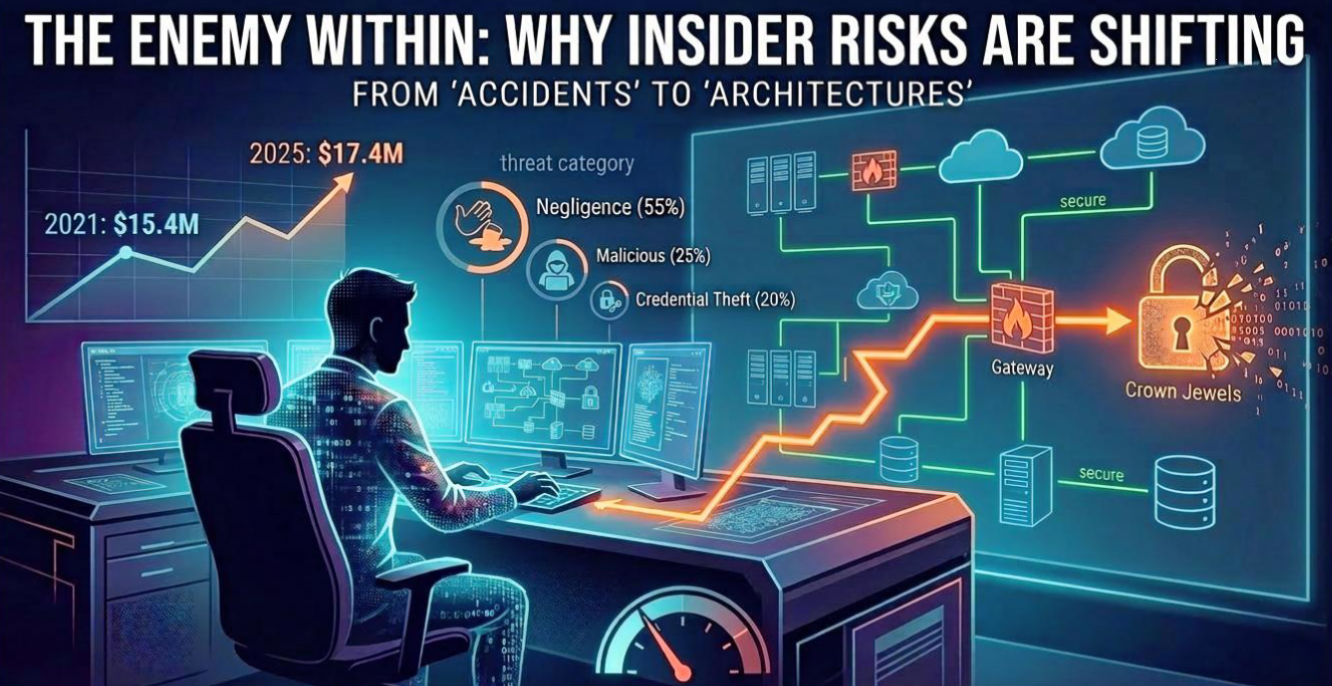
For years, we treated the “insider threat” as the occasional employee leaving a laptop in a taxi or a disgruntled worker making a scene on their way out the door. But the latest data from 2025 tells a much different story. The insider risk landscape has evolved into a sophisticated, multi-billion dollar problem that is now the single most expensive initial attack vector for a business.
According to the latest research from Ponemon, Verizon, and IBM, the average annual cost of dealing with insiders has climbed to $17.4 million per organization. What is even more striking is how the “why” behind these incidents is changing. We are seeing a move away from simple negligence toward a world of “blended” threats where external attackers exploit internal credentials.
The Five-Year Financial Climb
If we look at the last five years, the trajectory is clear. The financial burden of insider threats has grown by roughly 40% since 2021. While detection tools are getting better, the complexity of remediation in hybrid and cloud environments keeps the price tag high.
Table 1: The Annual Cost of Doing Business with Insider Risk
This table tracks the average annual cost per organization to manage and remediate insider-related incidents over the last five years.
| Year | Average Annual Cost (USD) | Annual % Increase |
| 2021 | $15.4 Million | — |
| 2022 | $15.9 Million | 3.2% |
| 2023 | $16.2 Million | 1.9% |
| 2024 | $16.9 Million | 4.3% |
| 2025 | $17.4 Million | 3.0% |
Negligence is Constant, but Malice is Expensive
The 2025 Ponemon Global Cost Study confirms that the “careless employee” still accounts for the majority of incidents. However, when a malicious actor gets involved, or when credentials are stolen to impersonate an insider, the costs per incident skyrocket.
A malicious breach now costs an average of $4.92 million per incident, which actually exceeds the global average cost of a standard data breach. This is likely because insiders know where the “crown jewels” are kept, making their theft far more efficient and damaging than an external spray-and-pray attack.
Table 2: Breakdown of Insider Incidents by Type (2025)
This table compares the frequency of different insider threat categories against their specific financial impact per incident.
| Threat Category | % of Total Incidents | Avg. Cost Per Incident | Primary Driver |
| Negligence | 55% | $676,517 | Phishing, Misdelivery, Shadow AI |
| Malicious Insider | 25% | $715,366 | Financial Gain, Espionage |
| Credential Theft | 20% | $779,797 | Impersonation, MFA Bypass |
The Time-to-Containment Crisis
The data shows a direct “punishment” for slow response. Teramind and Ponemon research highlights that if you can contain an insider incident in under 31 days, you might walk away with a $10.6 million annual bill. If it lingers past 90 days, that cost nearly doubles to $18.7 million.
The good news? For the first time in years, the average time to contain an incident actually dropped to 81 days in 2025, down from 86 days in 2023. This is largely credited to the adoption of AI-powered User and Entity Behavior Analytics (UEBA), which helps security teams spot the “signal” of a compromised account in the “noise” of daily operations.
Final Thoughts
Organizations that invest in proactive monitoring rather than just reactive containment are the ones seeing their costs stabilize. As we move further into 2026, the focus will likely shift toward securing the “AI supply chain” and unmanaged devices, which Verizon identifies as a major source of credential leaks.