
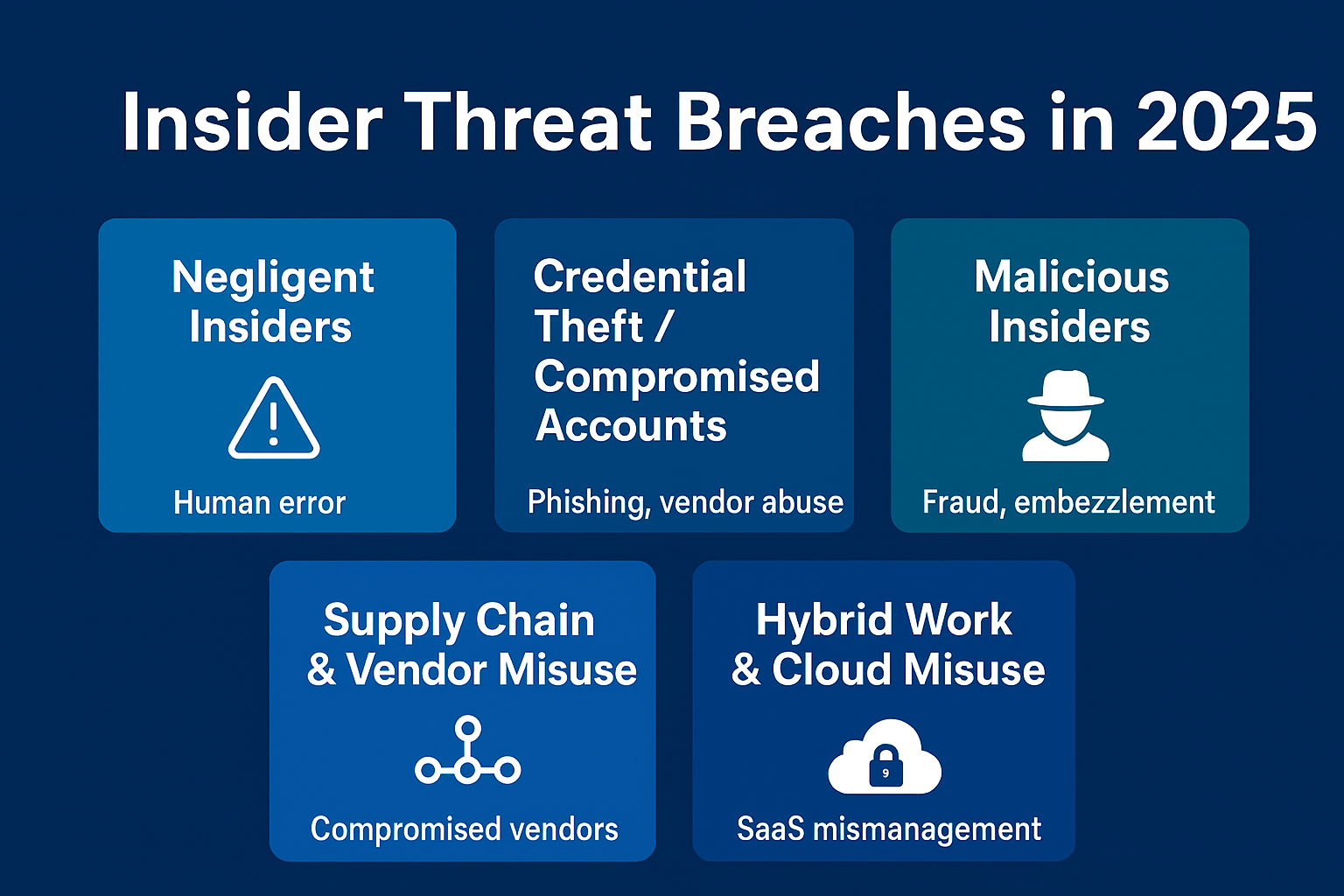
Insider threats were one of the most pressing cybersecurity challenges in 2025. Organizations across industries faced breaches caused not only by external attackers but also by employees, contractors, and trusted partners. These incidents were not always malicious. Many stemmed from negligence or credential theft. Yet the impact was consistently damaging, with costs rising and containment times stretching longer than most companies could afford.
This post explores the major categories of insider threat breaches in 2025, highlights real world examples, and explains why these incidents matter for every enterprise.
Negligent Insiders
Negligence remained the most common insider threat category in 2025. Employees unintentionally exposed sensitive data or created openings for attackers.
- Misconfigured cloud storage led to healthcare records being exposed in multiple incidents. According to the National Insider Threat SIG April 2025 report, human error was the leading driver of insider breaches in healthcare and education.
- Shadow IT use, where employees adopted unsanctioned SaaS tools, caused accidental leaks of sensitive information.
- Phishing remained a major issue. Employees clicked AI-generated phishing emails that bypassed traditional detection systems, as documented in the SpyCloud Insider Threat Pulse Report 2025.
Negligent insiders were not malicious, but their mistakes often triggered regulatory fines and reputational damage.
Credential Theft and Compromised Accounts
Credential theft was the costliest insider threat category in 2025. Attackers exploited stolen or phished credentials to gain access to critical systems.
- Vendor credential abuse was a recurring theme. Attackers compromised managed service provider accounts to infiltrate client networks, bypassing perimeter defenses. This was highlighted in Redbot Security’s 2025 Breach Year in Review.
- Phished employee accounts were used to siphon funds from financial systems.
- North Korean IT operatives posed as job applicants to gain insider access, a tactic documented in Infosecurity Magazine’s Top 10 Cyber-Attacks of 2025.
The average cost per credential theft incident was $779,000, according to DeepStrike Insider Threat Statistics 2025. These breaches also took the longest to contain, averaging 81 days.
Malicious Insiders
Malicious insiders deliberately exploited their access for personal gain. These incidents were less frequent than negligence but far more severe in impact.
- The April 2025 Insider Threat Report documented cases of embezzlement, contracting fraud, bribery, and kickbacks.
- Insider involvement in Chinese talent recruitment plans led to theft of intellectual property from technology firms.
- Departing employees took trade secrets within 90 days of resignation, a trend noted in multiple industry reports.
These breaches often resulted in financial losses so severe that companies faced layoffs or closure. The reputational damage was equally devastating.
Supply Chain and Vendor Insider Risk
Supply chain breaches were a growing insider threat in 2025. Vendors and contractors became major risk vectors because they often had trusted access to enterprise systems.
- Attackers compromised Oracle E-Business Suite accounts, which were later exploited by the Clop ransomware group.
- Breaches at major technology vendors allowed attackers to move laterally into client networks.
These incidents amplified systemic risk. A single compromised vendor account could cascade across dozens of organizations.
Hybrid Work and Cloud Misuse
Hybrid work and cloud adoption dissolved traditional security perimeters. Employees unintentionally exposed sensitive data through collaboration platforms or misused cloud credentials.
- SaaS mismanagement led to unauthorized access in healthcare and education.
- Remote work environments increased the complexity of IT systems. According to DeepStrike Insider Threat Statistics 2025, 76 percent of organizations cited hybrid and cloud environments as drivers of insider risk growth.
These breaches were often moderate in cost but widespread in frequency, making them a persistent challenge.
Why This Matters
The average annual cost of insider threats reached $17.4 million per organization in 2025, up from $16.2 million in 2023 (DeepStrike Insider Threat Statistics 2025). Eighty three percent of organizations reported at least one insider attack during the year. Healthcare, financial services, and education were especially vulnerable to insider-driven extortion and fraud.
Insider threats are not going away. They are evolving alongside hybrid work, cloud adoption, and increasingly sophisticated phishing campaigns. Organizations must invest in detection, response, and cultural awareness to reduce risk.
Sources
- National Insider Threat SIG April 2025 Report: https://www.cdse.edu/Training/Insider-Threat
- DeepStrike Insider Threat Statistics 2025: https://www.deepstrike.com/reports/insider-threat-2025
- SpyCloud Insider Threat Pulse Report 2025: https://spycloud.com/resources/insider-threat-pulse-2025
- Redbot Security 2025 Breach Year in Review: https://redbotsecurity.com/2025-breach-year-in-review
- Infosecurity Magazine Top 10 Cyber-Attacks of 2025: https://www.infosecurity-magazine.com/news/top-10-cyber-attacks-2025